Want to Translate a Video Game? Read This
Have you seen our Localization 101 Guide? This article will help you understand what localization is, what it entails, and the different elements involved in the process. __________________________________________________ Fancy becoming a video game translator? You must know it’s not going to be as easy and…

9 min read
Have you seen our Localization 101 Guide? This article will help you understand what localization is, what it entails, and the different elements involved in the process.
__________________________________________________
Fancy becoming a video game translator? You must know it’s not going to be as easy and fun as it sounds. You need more than just your fondness for video games and basic knowledge of your local language and the language used in the original copy of the game.
In this continuation of our localization series, we will discuss different aspects of video game translation and the things that make it uniquely challenging for translators. Go over the points below and evaluate your suitability in localizing the texts and audios of a video game. For more insights on localization in general, visit our ultimate guide for localization.
Video game translation almost always means localization
The task of converting a video game from one language to another cannot be a simple word-by-word translation process or the use of translation software. The game has to be localized to produce something acceptable, especially to gamers who know some English. The concern is not just about wrong grammar like what happened in the infamous “All your base are belong to us” in the translated version of the Japanese game Zero Wing. Video game publishers that don’t want to disappoint their fans with poorly translated game texts and audio should go for full-blown localization.
The idioms and expressions used in some games may need to be converted to their local equivalents. Also highly important is the challenge of translating humor. Many modern games are filled with jokes, gags, or other funny scenes that endear gamers. Failing to properly translate them would be a big disservice for the gaming community. Maybe “disservice” is too big a word to describe it, but serious gamers easily get disappointed when their favorite games are butchered by incorrect translations.
There are several people involved
A video game project involves a team typically composed of a project manager, translators, and voice talents. Don’t expect it to be completed by one, two, or three people. A team of five may not even be enough. It depends on how big the video game is. If the translation project is only for a small mobile game, a few people may be able to handle the different tasks required. However, for major PC and console (PlayStation, Xbox, or Nintendo) video games, the job would need several people specially to do the dubbing.
To recap, the following are the basic functions that should be fulfilled competently to deliver quality video game localization.
- Project management. Project managers plan and oversee everything that needs to be done including the pooling of translators and dubbers. Project managers need to be proficient in the source and target languages as they will be doing quality control or source and target text comparisons unless a separate person is hired to do it. The project manager coordinates with the client to list all the information that needs to be translated.
- Video games are a special type of media. They may use jargon or special language only dedicated gamers or gaming fans can understand. That’s why most translation companies rely on freelance translators when they have video game localization projects. The translators need to be gaming-savvy and familiar with the idiosyncrasies of gamers. It’s not enough that they translate the thoughts correctly; they have to put them in words gamers are more accustomed to. Technically correct translations may not be relatable or may sound off to gamers.
- Localization does not stop with textual translations. Video games have dialogs, taunts, cheers, and other sound effects that should also be localized. To do these speech translations, the project will have to enlist voice talents or dubbers. It’s important to cast the right voice actors for the project for consistency and the most suitable pronunciation. Also, as much as possible, the voices should be similar to that of the original dubbing.
If you want to be part of a translation team but the only skill you can be confident with is your ability to speak and read or write in the source and target languages, you can aim for a dubber role. It requires the least level of skill, but you should have the voice to provide the suitable localized version of the voices in a video game. You can dub for 3 to 5 characters depending on your ability to change your voice. The project manager or the client will have to decide if your vocal manipulations are credible enough to serve as the voice of multiple characters.
The process is long and meticulous
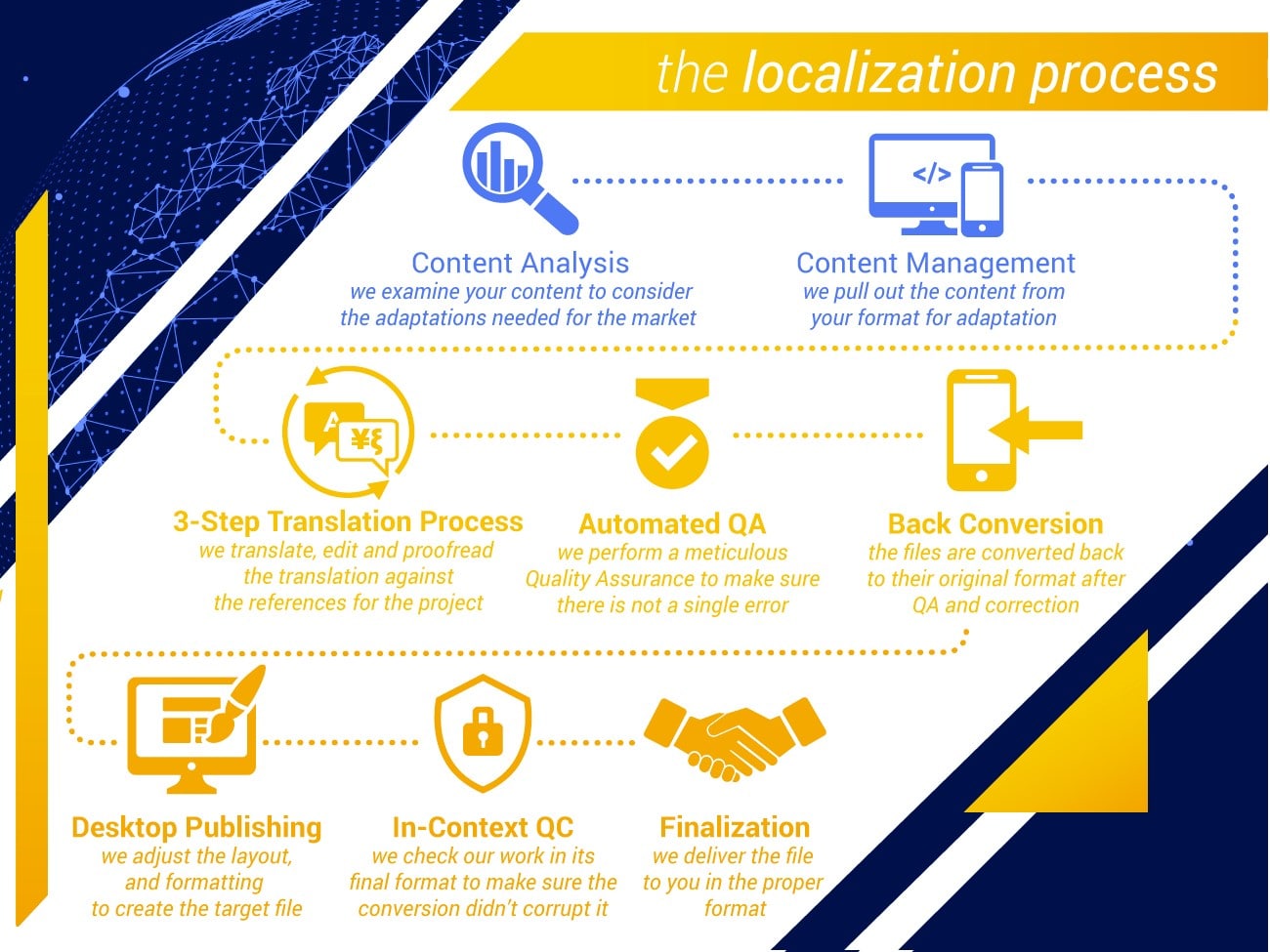
A localization team that cares about the quality of its output goes through a rigorous process, something similar to what is described below.
- It starts with the content analysis wherein the material to be translated is comprehensively examined to find the details that need translation. This step is undertaken in relation to the targets set by the client. There are instances when the translations don’t only cover texts and audio, but also include graphics with texts in them or graphical objects used as references during dialogs. Modifications may be introduced for these. Note: More discussions about these changes are presented in the succeeding section (“Some changes may be needed…”).
- The next step is content management. Here, all the content intended for translation are copied, organized, and assigned to their respective translators. In the case of video games, these include the sound files and the game code in which the texts appearing in the video game are embedded.
- The actual translation process follows. It usually consists of the translation, editing, and proofreading phases. For speech translations, instead of proofreading, the audio files are meticulously examined to check for mistakes or problems such as garbled speech and volume inconsistencies.
- Once the translation process is completed, quality analysis is then executed to ascertain that the translations are correct and translation errors (misspellings, wrong details) are fixed.
- After checking the quality of the output, back conversion is implemented. This means that the files are converted to their original formats. The text translations, for example, are copied into the code of the video game while the speech translations are converted to mp4, WAV, WMA, or the format used by the client. Some translation service providers may do another quality analysis cycle for the video game’s code to make sure that the code works perfectly with the translated materials infused.
- When everything has been checked for accuracy and compliance with the requirements of the client, the output is finalized for submission. The translations are scrutinized in their final format. In video game translation context, this could mean having to do a comprehensive walkthrough of the game to see if everything is where they are supposed to be. Some clients, however, simply ask for the translations and insert them into the game on their own.
If you want to know more about localization in the gaming industry and its impact, check our free ebook guide on the subject.
Some changes may be needed to take out offensive content or parts that may be censored.
There are times when video games contain dialogs, texts, or graphics that might offend certain people, create confusion, or make the game prone to censorship. They may contain curses deemed too obscene or suggestive. There may be images used as references by the characters in the game that can adversely affect commercial viability. The game may feature racist or culturally and politically sensitive remarks. The dialogues may stir controversies that would generate bad publicity for the game. Moreover, the game may appear similar to some other games released earlier.
A game wherein the lead character lambasts communism or promotes Falun Gong, for example, will not do well in the Chinese market. Something that casually mentions the swastika (along with images of it) will be deemed highly offensive. Similarly, a game that makes fun of Islamic figures or makes light of terrorism-related terms can lead to serious consequences.
A good localization team does not only provide translations for a video game, but it should also advise the client about the potential issues in the game’s content. Competent and experienced localization service providers are aware of and up-to-date with the various commercial and socio-political issues that can affect the marketability of a video game. They are expected to suggest changes like converting a swastika to a cross (and changing its name in the dialogues) and giving a different name for communism or Falun Gong.
The takeaway
Again, plain passion for video games and basic skills in the source and target languages are not sufficient to become a video game translator. But you can settle for a voice talent role if you really want to get involved with your minimal applicable skills. If you want to play a significant function, you need to be well-versed in how the video game industry works. You need to be updated with gaming lingo and culture. Additionally, you have to be prepared for the stringent processes and the meticulousness needed to perfectly localize a game.
Allow us to help you provide the best translation for your video games
Avoid the embarrassing mistakes of mistranslations in your video games by letting Day Translations, Inc. do the job. We have been in the business of helping individuals, organizations, and businesses produce the best localized versions of their products including video games, movies, and multimedia content. We provide impeccable language services with our global network of translators who are native speakers of the languages they specialize in. Email us at Contact us or give us a call at 1-800-969-6853. We are ready to address your needs 24 hours a day, 7 days a week, and 365 days a year.
This is part of our Localization series. To learn more about localization, go to our Ultimate Guide for Localization.

Written by
Day TranslationsThe Day Translations editorial team is composed of seasoned linguists, translators, and localization experts with a deep passion for language and cross-cultural communication. With decades of combined experience in translation, interpreting, and multilingual content creation, the team brings a unique perspective on the evolving world of global communication. Their insights reflect both academic expertise in linguistics and hands-on experience. Each article is crafted to inform, inspire, and support professionals navigating the multilingual landscape.
Stay in the loop
Get the latest articles on translation, localization, and language delivered straight to your inbox.