Translation Project Management: Full Guide for PMs
Let’s say you want to translate your employee handbook from English into Spanish to make it accessible for your recent Colombian hires. You need a translator, right? But what if your onboarding and HR materials cover a range of text and audiovisual formats? Now, not…

12 min read
Let’s say you want to translate your employee handbook from English into Spanish to make it accessible for your recent Colombian hires. You need a translator, right?
But what if your onboarding and HR materials cover a range of text and audiovisual formats? Now, not only do you need a translator, but also subtitling and voice-over experts.
And if your e-commerce department is hoping to expand overseas by translating its website into 8 different languages? A single translator—or two—simply won’t cut it. You need a full-scale translation team comprised of linguists, editors, localization experts, and a translation project manager to steer the ship.
Whether you’re planning to outsource or put together your own in-house team, translation project management is essential for coordinating staff, meeting tight deadlines, and ensuring quality, accuracy, and consistency in the final product.
In this guide, you’ll learn to identify when to use project management, what translation project managers actually do, the key phases of the translation project process, the best tools to employ, how to scale your workflow, as well as solutions to common challenges and tips for getting started in the role.
When Do You Need Translation Project Management?
Translation project management offers a structured approach for complex translations that involve multiple files, different content formats, more than one language, and/or strict deadlines.
You need a translation project manager when:
- You’re localizing a product or website into several languages, like the latest role play video game out of Japan, or a documentary series for Netflix.
- Consistency is key. You’ve got multiple files and formats, and they all need to look like they go together!
- You’re managing multiple freelancers or vendors, across different time zones, languages, and cultural norms.
- There are regulatory or quality requirements (e.g., legal, medical). Think USCIS for immigration, or HIPAA for healthcare.
- Deadlines are non-negotiable. Because, honestly, when are they not?
In fact, even small projects can benefit from having a manager to oversee client expectations, translator performance, and the final review process. This is especially important when there’s a lot riding on the translated product, like the success of a new start-up, ROI, and company reputation.
What Does a Translation Project Manager Actually Do?
A translation project manager (PM) is the coordinator who keeps everything on track and running smoothly. Their main responsibilities include:
- Defining project scope and deliverables
- Assembling and managing translation teams
- Setting timelines and tracking deadlines
- Communicating with clients and linguists
- Performing quality assurance checks
- Managing CAT tools and translation management systems (TMS)
PMs are the glue that holds it all together. They act as a go-between, making sure that clients’ needs are effectively conveyed to translators. When large documents are divided up among multiple linguists, PMs standardize the terminology and format so that the final file is seamless. Ultimately, project managers are the ones operating behind the scenes to ensure that errors get fixed and deadlines get met.
The Translation Project Management Process
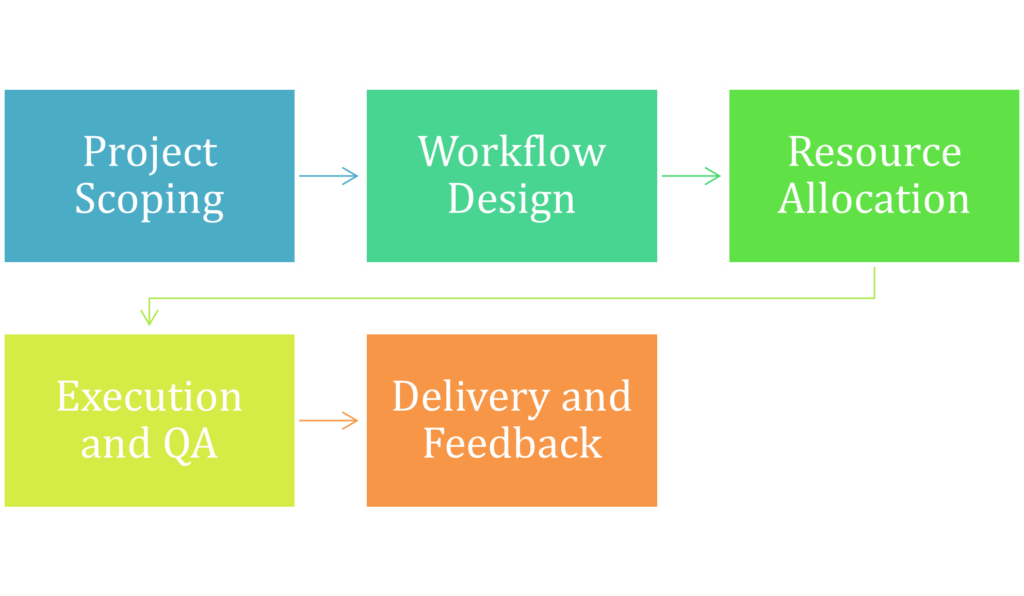
Translation projects typically follow these phases:
1. Project Scoping
The PM works with the client to determine the target language & audience. They receive the files and determine word counts. Based on the language, complexity, and volume, they negotiate cost and deadlines.
2. Workflow Design
The PM determines which steps to include in the project (translation, editing, proofreading, QA, etc.).
3. Resource Allocation
The PM selects resources (translators, editors, etc.) based on their language competence and subject-matter expertise, and confirms their availability and capacity. For longer projects, the PM establishes a timeline for communication and partial deliveries.
4. Execution and QA
The PM finalizes task assignment by email or the TMS (translation management system). While most of the work here is done by the linguist, the PM is available to track progress, provide support, and move the translated product along (e.g., from translator to proofreader). Finally, the PM performs QA checks to confirm accuracy and consistency.
5. Delivery and Feedback
The PM receives the final product from the last reviewer (editor, proofreader, or QA expert) and submits it to the client for feedback. If the client requests any edits or adjustments, the PM coordinates these with the linguist team until the client is completely satisfied.
Tools Every Translation Project Manager Needs
Project management tools can be a lifesaver, and they’re a must-have if you’re trying to increase your efficiency and scale your business. In particular, modern PM tools with client portal capabilities allow you to seamlessly involve clients without exposing internal workflows. Here are the most popular tools that skilled project managers swear by:
| Tool Type | Popular Options | Uses |
| Translation Management (TMS) | Smartling, XTM, Memsource | Automate workflows, assign tasks |
| CAT Tools | SDL Trados, memoQ, Wordfast | Segment, translate, and manage terminology |
| QA Tools | Xbench, Verifika | Detect and correct consistency and formatting errors |
| Communication Platforms | Slack, Zoom, Microsoft Teams | Keep all team members connected and on the same page |
| File Sharing & Storage | Google Drive, Dropbox, SharePoint | Secure and organize project files |
| Time & Task Management | Trello, Asana, Monday.com | Track progress and deadlines |
| CRM Tools | Salesforce, Zendesk, Pipedrive | Track project details and interactions with each client |
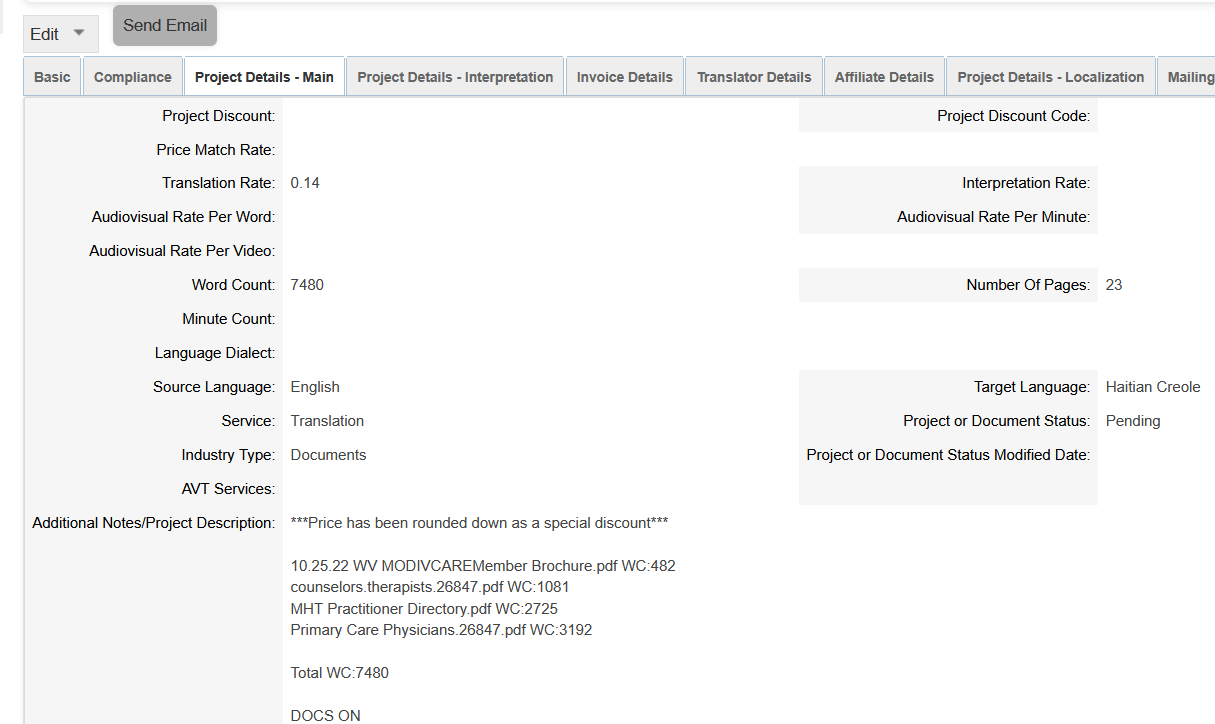
Here’s one example of how the right CRM (customer relationship management) tool can help you keep track of projects, client interactions, and established translation rates:
How to Build a Scalable Translation Workflow
As your company expands to accommodate more languages, different file formats, and greater translation volumes, your workflow must adapt to keep up with the greater demand. Here’s a look at some recommendations for making your work scalable, without sacrificing the high quality your customers expect:
- Use a TMS to centralize project tracking. See the table above for some of the most popular TMS options
- Build a vetted pool of translators and editors by language and subject-matter expertise. Keep this list organized in a database to easily filter and access the information you need
- Create and maintain translation memories (TMs) and termbases. Good translation memories and CAT tools can save you and your translators a wealth of time, speeding up the translation process and helping maintain consistency
- Standardize QA processes across languages. Once you’ve found a QA rhythm that works for you, write it down (i.e., SOP, standard operating procedure), rinse and repeat
- Document your workflows for easy onboarding. The same goes for the overall workflow. Make sure your procedures are documented, so newer PMs don’t have to reinvent the wheel!
Scalable workflows help you take on greater volumes of work, make more money, and maintain the quality that has your customers coming back for more.
Common Challenges and How to Solve Them
1. Inconsistent Quality
Your translators submit translated files that vary wildly in tone, terminology, or formatting, sometimes even within the same project. One document reads smoothly, another feels awkward. Clients complain about inconsistencies, especially in technical terms or brand voice.
Possible Solutions:
- Implement a TEP (Translation, Editing, Proofreading) workflow. Assign each step to different professionals so no errors slip through the cracks. More eyes on your translated document can make all the difference.
- Use QA tools like Xbench or Verifika to flag inconsistencies in terminology, untranslated segments, and formatting errors.
- Provide detailed style guides and glossaries to define tone, preferred terminology, punctuation rules, and formatting standards before the project starts.
Pro tip: Build and update translation memories (TMs) to enforce consistency across recurring content.
2. Missed Deadlines
Projects that should take a week stretch into two or three. Freelancers drop off the radar, and clients get frustrated. Imagine a marketing campaign is scheduled to launch on a Friday, but the German translation isn’t ready until Monday. Your client already paid for ad slots over the weekend, and that money goes down the drain.
Possible Solutions:
- Use project management tools like Smartcat, memoQ PM, or Trello to assign tasks, set deadlines, and automate progress tracking.
- Break down projects into daily deliverables and check in every 24 hours to prevent last-minute surprises.
- Use automated reminders and calendar syncs to keep everyone aligned.
Pro tip: Give your translators and proofreaders a deadline that is at least 24 hours ahead of the ideal submission time to give yourself some wiggle room and time to make any adjustments long before final submission to the customer.
3. Tool Overload
You’re juggling five different platforms—email, Slack, Google Drive, CAT tools, and spreadsheets—and constantly losing track of updates, files, or messages. For example, your translators deliver files via email, QA feedback comes through Slack, billing is managed in Excel, and deadlines are tracked in Asana. One update doesn’t make it into the final version because it was buried 10 messages deep in a chat thread.
Possible Solutions:
- Consolidate platforms by choosing a comprehensive TMS (like Memsource or Smartcat) that handles assignments, CAT integration, file management, and communication.
- Use integrations and automations where possible. Lnk Slack with your TMS, or use Zapier to send deadline alerts.
- Set rules for communication and file delivery. For example, “All final files must be uploaded to [shared drive or platform]. No email attachments.”
Pro tip: Create a checklist of tools used for each project and stick to it. Don’t introduce new platforms mid-project unless absolutely necessary.
Translation Project Management Tips for Different Content Types
Not all projects are created equal. Depending on the type of content your translation team is translating, your job as a PM needs to consider special tasks and nuances. Here are some of the most common content types you may encounter, and a few tips for managing them:
- eLearning
○ Focus on layout and character limits
○ Localize voiceovers and subtitles
○ Use tools that support SCORM/xAPI formats
- Legal
○ Make sure translators have legal expertise
○ Prioritize confidentiality and compliance
○ Track versions meticulously
- Marketing
○ Transcreate rather than translate
○ Maintain brand voice and tone
○ Use market-specific reviewers
- Technical
○ Follow glossaries strictly
○ Ensure accuracy in units, specs, and terminology
○ Use XML or JSON-compatible tools
Freelancers vs Agencies vs In-House: Who Should Manage the Project?
By now, you’ve likely come to realize that you need to hire someone to manage your translation project. And unless you already have an experienced project management area, you may be wondering how to go about putting together your team.
For one-off, single-language translation projects that are simple and straightforward, hiring a freelancer may be the best option for you. Freelance translators may be more cost-effective, but you need to choose someone who you’ve vetted and can rely on to independently manage the translation, proofreading, and quality assurance. While some freelancers have networks they use to outsource, many are used to working alone, and may not be the best managers for larger projects where quality is key.
Translation agencies, like Day Translations, are an excellent option when you’ve got the budget and want to count on an experienced project management team. These teams know what they’re doing. They often have access to large networks of linguists and can find the right person for any job. They also guarantee the final product has passed through a series of reviews and QA processes.
In-house teams can be a great option for companies that continuously need to translate documents, websites, or product specs. If your company has the budget for an in-house team of at least 3 or 4 full time managers, plus freelance linguists, this might be the right choice for you. But remember, even if you hire experienced PMs, there will always be a learning curve. You must also take into account onboarding, training, and employee benefits packages.
Ultimately, consider your project’s complexity, timeline, and budget to select the right model for you. You might even find a hybrid system is the best approach.
How to Become a Translation Project Manager
Let’s say your company has decided to build an in-house translation project management team, and you’re ready to jump into this role. Here are a few things to consider to make sure you are up for the task:
- Education: Degrees in translation, linguistics, or project management are ideal. PMs should have a language background and proficiency in at least one other foreign language to ensure they understand both the source and translated documents.
- Tools: Get comfortable with CAT tools and TMS platforms. Research the different options, or study up on the platforms your company is already working with.
- Experience: Start with small projects or internships. Translation experience is extremely helpful so you can see things from both sides of the coin.
- Certifications: Ready to commit and take things to the next level? Pursue PMP or ATA certifications for added credibility.
- Soft Skills: Communication, multitasking, and attention to detail are just a few of the key skills translation project managers need to master.
The good news is that if you’re a translator looking to branch out into translation project management, studies show that you’ve likely already got most of what it takes. Just remember to start small and scale as you feel able to take on more responsibility and more complex jobs.
Final Takeaway: PMs Are the Backbone of Translation Success
Translation project management goes far beyond assigning tasks, ticking off checklists, and tracking deadlines. It’s about making sure every piece of content is accurate, culturally appropriate, and consistent—no matter the language or market. Whether you’re working in a company looking to expand into new language markets or building your career in the translation market, knowing how to navigate the project management side of translation can be a huge asset.
With the right systems in place, translation project managers play a key role in keeping multilingual projects running smoothly. They’re the liaison between clients, translators, and technology—making sure quality remains high and nothing gets lost in translation.

Written by
Kimberlyn Owens-HughesKimberlyn has 20+ years of experience in the language field. With a BA in Spanish and an MA in Teaching English as a Foreign Language, she moved from her home in Nashville, Tennessee, to Valparaiso, Chile back in 2006. Soon after, she began collaborating as one of Day Translations' first Spanish-to-English translators. Over the years, she has shared her passion for language as an English instructor at local Chilean universities, and as a professional translator for the financial, legal, academic, and tourism sectors. She enjoys learning new things in her research and work as a translator, but her true love lies in literature, writing, learning new languages, and travel. As Day Translations' Content Manager, she is able to cultivate this love of language and writing to share her passion and expertise with the world.
Stay in the loop
Get the latest articles on translation, localization, and language delivered straight to your inbox.