How Translation Bots Work. Are They Better Than Human Translators?
Machine translation is on the rise. Google Translate, as well as other automated translation solutions like Bing Microsoft Translator, Babel Fish, PROMT, ImTranslator, have significantly improved over the years. With the help of neural networks and deep learning, they are now capable of translating more…

10 min read
Machine translation is on the rise. Google Translate, as well as other automated translation solutions like Bing Microsoft Translator, Babel Fish, PROMT, ImTranslator, have significantly improved over the years. With the help of neural networks and deep learning, they are now capable of translating more languages with better accuracy.
One of the notable aspects of machine translation is the use of bots. What are they? How are they related to search engine bots? Know the answers to these questions and more in the following discussions.
Translation bots – Introduction
Translation bots are like AI virtual assistants that specialize in language translation. They can interact with a user textually or verbally. They are usually comparable to messenger services, i.e. you have to communicate with them through voice or text chat to have certain phrases or words translated to the language you want. It’s like exchanging messages with someone through chat or by talking to them to ask for a translation.
The “bot” in this phrase merely infers automation. It means that you no longer have to interact with a human attendant to use a certain translation service. It’s just like the customer service bots used by many commercial websites. They employ customer support bots to dispose of minor inquiries and concerns quickly and efficiently. Instead of inundating a human customer service representative with all of the incoming questions and complaints from customers, bots are deployed to handle simple questions and issues.
Search engine bots vs. translation bots
To do away with the confusion, it bears emphasizing that translation bots are very much different from search engine bots. While both “bots” here are short for “robots,” they mean entirely unrelated things. Also referred to as spiders, search engine bots are programs designed to crawl around the world wide web to index website pages. They seek out content on the internet for indexing, making it easier for search engines to pull out links to content in the SERPs (search engine results pages).
Translation bots, on the other hand, are software designed to facilitate interaction with a translation system. They are intended to make it easy to use a translation platform. Powered by artificial intelligence, they are similar to chatbots or are essentially a type of chatbot. They simulate conversations with humans, to make the use of a translation service somewhat engaging or less impersonal. A voice chatbot can further enhance this experience by enabling users to interact with the translation service using spoken language, adding a more natural and intuitive layer of communication.
What do translation bots look like?
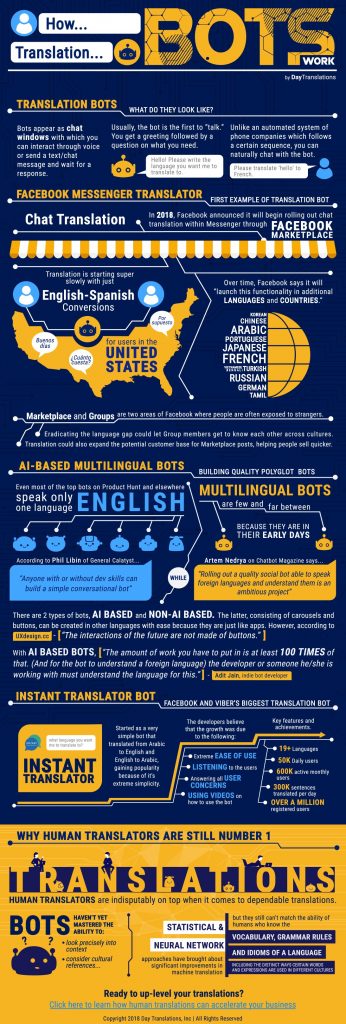
As mentioned, they are like messenger services. They appear as chat windows with which you can interact through voice or send a text/chat message and wait for a response. Usually, the bot is the first to “talk.” You get a greeting followed by a question on what you need.
Since translation bots are powered by artificial intelligence, the experience of using them is comparable to conversing with a real person. It’s unlike what you get when you contact (by phone) the automated system of phone companies, wherein you are asked to press certain numbers to be directed to the channel that can provide the answer you are looking for.
With AI-powered translation bots, the conversation does not have to follow a certain format or sequence. For example, if you want to have a phrase translated to French, the process will not be something like this: (1) the bot greets you, (2) asks you a question, (3) directs you to choose a keyword for the language you need, and (4) asks you to enter the word, phrase, or sentence you want to be translated. Instead, you can naturally chat with the bot to request for the translation you want. For example, after the bot greets you, you can just say “Please translate ‘hello’ to French.”
Many translation bots can already understand what you intend to get. Some may clarify the language you want first, but most of the time they can readily comprehend your request.
Examples of translation bots
Some of the popular translation bots are as follows:
- Facebook Messenger Translator. This is regarded as the first example of a translation bot.
- Instant Translator. This Facebook and Viber bot can be used for translating in 10 languages. It is known as the biggest translation bot on Facebook.
- Google Translate Bots. Many bots make use of Google’s translation service. These include the interface you see when you go to translate.google.com, the prompts in Chrome that ask you if you want a page translated, and various third-party bots that make use of Google’s renowned translation platform.
- Discord Translator. This bot is specially created to facilitate communication among gamers on the Discord chat board. It supports more than 100 languages.
- (Telegram) Translate Bot. A command-based bot, you can get translations with it using commands such as /translate_to, /translate_this, or /auto_translate.
- Ru Bots. You can use the translation service of Translate.ru by simply adding Translate.ru bot to your Skype and Telegram contacts.
How do translation bots work?
Translation bots are not complete translation services or platforms themselves. They are more of an interactive interface for a translation service. They only connect a user to a translation service through an AI-powered text or voice-based interface.
There are non-AI translation bots, but they are most likely headed for obsolescence. They are characterized by the use of carousels and buttons, hence not as easy and intuitive to use as AI-powered ones. Using them is mostly a procedural experience, so they don’t create a natural interaction with the system.
- Translation bots simply obtain the information needed to be fed into the actual machine translation platform. Once the translation is generated, the bots then present the output to the user. In other words, the bot refines the information from the user so it can be easily understood by the machine translator, and delivers the resulting translation to the user in good text or audio form.
- Bots relegate the actual job of converting messages from one language to another to established machine translation platforms such as Google Translate, Babelfish, Skype Translator, or Facebook Translator. That’s why you often see Translator bots as add-ons to apps or web-based services. Instant Translator, for example, is not a standalone app but something you add to Facebook or Viber.
- There are also bots that don’t have to be installed as an add-on but added as contacts in a messaging service. For example, you can add Translate.Ru as a contact on Skype (through “join.skype.com/bot/e0255810-48d1-42da-b657-8388c4eca5ae.”) or Telegram (through “t.me/TranslateRuBot”). Once you have them on your contact list, you can send messages to them to request for translations.
The actual machine translation
The basic idea of machine translation is as follows: (1) the decoding of the meaning of the text/message and (2) the re-encoding of the meaning in the target language.
These sound simple, but they are more complex than what you may imagine. Several people are involved in making sure that the computer-based decoding of meaning is correct. They have to come up with a program that matches the complex cognitive operation behind specific languages. There’s the need to figure out a comprehensive representation of grammar, semantics, idioms, semantics, and other aspects of a particular language in the translation system.
There are different approaches to this analysis and interpretation. These govern the evaluation of the various features of a string of text or message.
- Rule-based. This approach is usually used in producing dictionaries and grammar programs. It includes interlingual, transfer-based, and dictionary-based translation.
- Interlingual machine translation refers to the conversion of the text to be translated into a language-neutral representation before converting it into the target language.
- Transfer-based translation is similar to interlingual except that it is partly dependent on the language pair involved.
- Dictionary-based translation, on the other hand, entails the use of word or phrase equivalents based on the entries in a dictionary.
- In this approach, the system uses statistical methods derived from bilingual text corpora like the EUROPARL and the Canadian Hansard corpus. This is the approach used in the early years of Google Translate and many other modern automated translators.
- Example-based. As the phrase implies, this approach makes use of exemplifications to generate translations. It employs a corpus with pre-translated texts, with which the text that is to be translated is compared to find the appropriate translation.
- Hybrid machine translation. This approach incorporates statistical and rule-based methods. It can mean the use of rules post-processed by statistics or statistics directed by rules.
- Neural machine translation. Based on deep learning, neural machine translation employs a massive artificial neural network to analyze and predict the message a string of text means, and convert it to the target language. Google Translate uses this approach at present, which arguably results in better translations.
Are translation bots better than human translators?
Certainly not. This question is rather superfluous. There’s no point comparing translation bots to human translators. These bots only represent machine translators, and it’s a fact that human translators are still significantly better than their machine counterparts.
Human translators are indisputably on top when it comes to dependable translations. The reasons for this can be summed up as follows:
- Machines haven’t yet mastered the ability to look precisely into context, and consider cultural inferences and unique expressions.
- Statistical and neural network approaches have certainly brought about significant improvements in machine translation, but they still can’t match the ability of humans who know not only the vocabulary, grammar rules, and idioms of a language, but also the distinct ways certain words and expressions are used in different cultures and in relation to specific events.
It’s worth pointing out, however, that translation bots can serve a complementary role. They can efficiently process the translation of simple words or phrases so they can quickly address simple language service needs that don’t require human proficiency. It’s even possible to create translation bots that can handle simple inquiries, and then refer users to human language service providers in case the translation job they need is too complex for machine translators to handle reliably.
Day Translation, for example, can incorporate a translation bot in its live chat support facility. This bot will handle the translation of simple words, phrases, or sentences. If the translation needed is for a long article or a document, the bot will then switch to a live support staff to discuss the potential translation project. This is an excellent way of integrating the efficiency of machine translation and the proficiency and experience of expert human translators.
Again, translation bots are not competitors to human translators. They are basically a facility for accessing machine translation platforms, but they can also serve as a virtual customer service representative for translation service providers.
Share this Infographic On Your Site

Written by
Bernadine RacomaBernadine Racoma is a senior content writer at Day Translations, a human translation services company. After her long stint as an international civil servant and traveling the world for 22 years, she has aggressively pursued her interest in writing and research. Like her poetry, she writes everything from the heart, and she treats each written piece a work of art. She loves dogs!
Stay in the loop
Get the latest articles on translation, localization, and language delivered straight to your inbox.