The Inuit Language: A Quick Guide
Learning about the different languages of the world is always a good thing, and today is no different. Have you ever heard about the Inuit language? If you haven’t, then the DT blog has something special in store for you today! Keep reading to learn…

5 min read
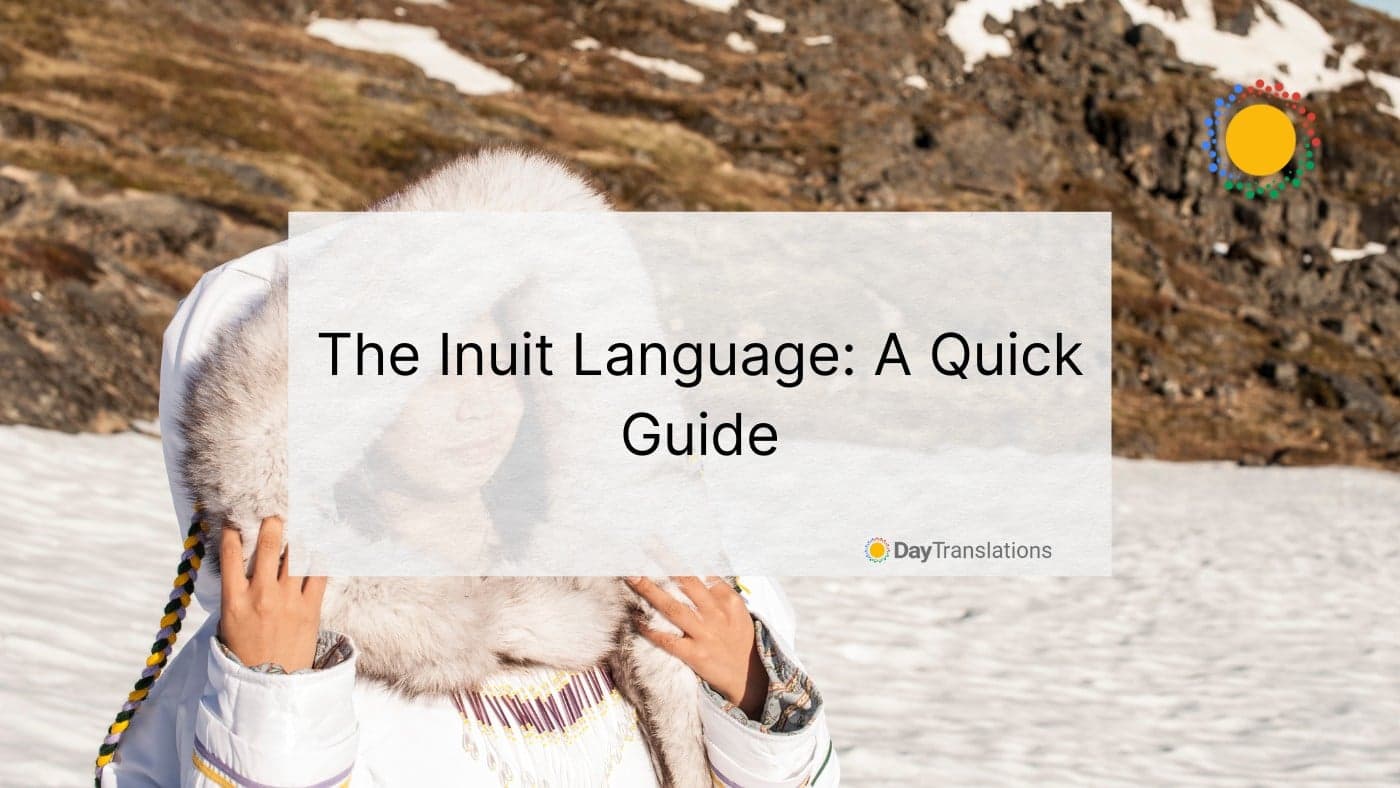
Learning about the different languages of the world is always a good thing, and today is no different. Have you ever heard about the Inuit language? If you haven’t, then the DT blog has something special in store for you today!
Keep reading to learn about the Inuit language, its origins, the different dialects, and the state of the language today.
What is the Inuit Language?
The Inuit is actually a group of languages spoken by an Indigenous group of people, also known as the Inuit people. These people are found in countries located in the northern hemisphere, namely: Alaska, Northern Canada, Greenland, and Denmark.
To be even more specific, 3 versions of the Inuit language, most commonly referred to as Inuktitut, is spoken in Canada and Greenland, while two other versions of the Inuit language are spoken in Alaska and are referred to as Inupiatun. Within their indigenous group, the Inuit people also have other names they use to refer to the language as well.
Presently, it’s hard to track the exact number of people who speak Inuit, but a rough estimate is 110,000 people from a global perspective. The breakdown is as follows:
- In Greenland and Denmark combined, there are roughly 57,000 speakers
- In Canada, there are around 34,000 speakers
- In Alaska, there are around 19,000 speakers
Canada has the most significant number of fluent Inuit speakers, and they’re in the province of Quebec. Statistics show that 100% of that population is fluent in their Inuit dialect. On the other hand, the region with the most significant number of speakers overall is Greenland and Denmark. The tourists ordering tours around Greenland and having a hop on hop off Copenhagen often become instinctively a witness to a great amount of Inuit native speakers there.
While the Inuit family of languages has official status in Canada, Greenland, and Denmark, within Alaska in the United States, the Inuit language holds no official status.
There are several dialects found within the Inuit Language. These varieties are based on their geographical location.
Facts About the Inuit Language
All versions of the Inuit language are pretty similar. With this in mind, speakers of neighboring versions of the language are, more often than not, able to understand each other. However, the farther the distance becomes between the speakers, the more difficult it becomes for them to understand each other.
In light of these facts, let’s take a further look at some more interesting facts about the Inuit language:
- Across the Inuit language family, there are a few similarities. For instance, Inuit use a base-20 numbering system as opposed to a base-10 numbering system that so many other languages use (including English). If you’re not sure what we mean, we’re talking about the decimal system (base-10).
- The majority of the Inuit languages use a voiceless sound system. This means that the placement of the tongue when speaking makes for ‘hard’ or ‘soft’ sounds. That said, these sounds are also some are among the most unique in the language world. In fact, these unusual sounds are only found in the Inuit, Zulu, and Welsh languages.
- Across all the Inuit dialects, there is a consistent writing system. This writing system comprises a modified version of the Latin alphabet.
- In Canada, for example, Inuktitut has a unique way of writing their syllables. In this case, one symbol represents one syllable.
- Other than having a solid relation to the Eskimo-Aluent language family, Inuit is not believed to be related in any way to any other language
The Key Features of the Inuit Languages
- Across all the dialects of the Inuit language, there are three basic vowels. These vowels can be short or long, and the length of the vowel makes a difference in the meaning of the word.
- Regarding consonants, they may vary slightly in how many consonants are found within the dialect. For example, there are 15 consonants found in the Nunavut dialect, while other dialects have many more.
- It is common practice that the Inuit language does not borrow words or phrases from other languages. Instead, their words are built from native elements.
Inuit Vocabulary
Here is some vocabulary you can practice from the Inuit language family:
- How are you? – Qanuipit?
- Goodbye – Tavvauvutit (to one person), tavvauvusi (to two or more people)
- Thank you – Qujannamiik
- Yes – Ii
- No – Aakka, aagaa
- Welcome – Tunngasugitsi
- It is snowing – Kannijuk
- I love you – Nalligivagit
Within the Inuit family of languages, there are quite a few ways to sayy snow. Here are some of them: aniu, apijaq, aput, isiriartaq, katakartanaq, kavisilaq, kinirtaq, mannguq, masak, matsaaq, natiruvaaq, pukak, qannialaaq, qannik, qiasuqaq, qiqumaaq.
Wrapping Up
So, there you have it, we just went through so entertaining and interesting facts about the Inuit language. We sure hope you learned something new.
Don’t forget that at Day Translations, we love languages and provide Translation, Interpreting, localization, and AVT services in every language. Our team of professionals is available to help you 24/7, 365 days a year. Contact us today!

Written by
Day TranslationsThe Day Translations editorial team is composed of seasoned linguists, translators, and localization experts with a deep passion for language and cross-cultural communication. With decades of combined experience in translation, interpreting, and multilingual content creation, the team brings a unique perspective on the evolving world of global communication. Their insights reflect both academic expertise in linguistics and hands-on experience. Each article is crafted to inform, inspire, and support professionals navigating the multilingual landscape.
Stay in the loop
Get the latest articles on translation, localization, and language delivered straight to your inbox.