Writing System Evolution: Origins of the World’s Alphabets
Have you ever looked at a foreign script and wondered why the letters look the way they do? Why is Thai so curly when Roman characters are angular? How did the Arabic script get such elegant, arching strokes, or the Hebrew writing system its compact…

5 min read
Have you ever looked at a foreign script and wondered why the letters look the way they do? Why is Thai so curly when Roman characters are angular? How did the Arabic script get such elegant, arching strokes, or the Hebrew writing system its compact efficiency?
The answer is that writing systems, like other living things, evolve. In fact, nearly every widely used writing system today, except one, share a common ancestor.
A Heritage Written in Stone
That common ancestor was a writing system developed in the Sinai desert about 4 thousand years ago. It was inspired by the hieroglyphics of the ancient Egyptians. This script developed into the Phoeneican alphabet, one of the most widely used alphabet systems in history.
You can still see Phoenecian writing system in modern language. It was a pictograph of an ox head, pronounced alep, and evolved into the Roman letter A.
The Phoenecian writing system spread around the Mediterrannean with the growing trade networks, and branched into the Greek and Aramaic writing systems.
Aramaic eventually developed into Hebrew and Arabic, while Greek became the basis of the Latin alphabet that we still use today. Remember the Phoenecian letter alep above? It also became the first letter, א or aleph, of the Hebrew writing system.
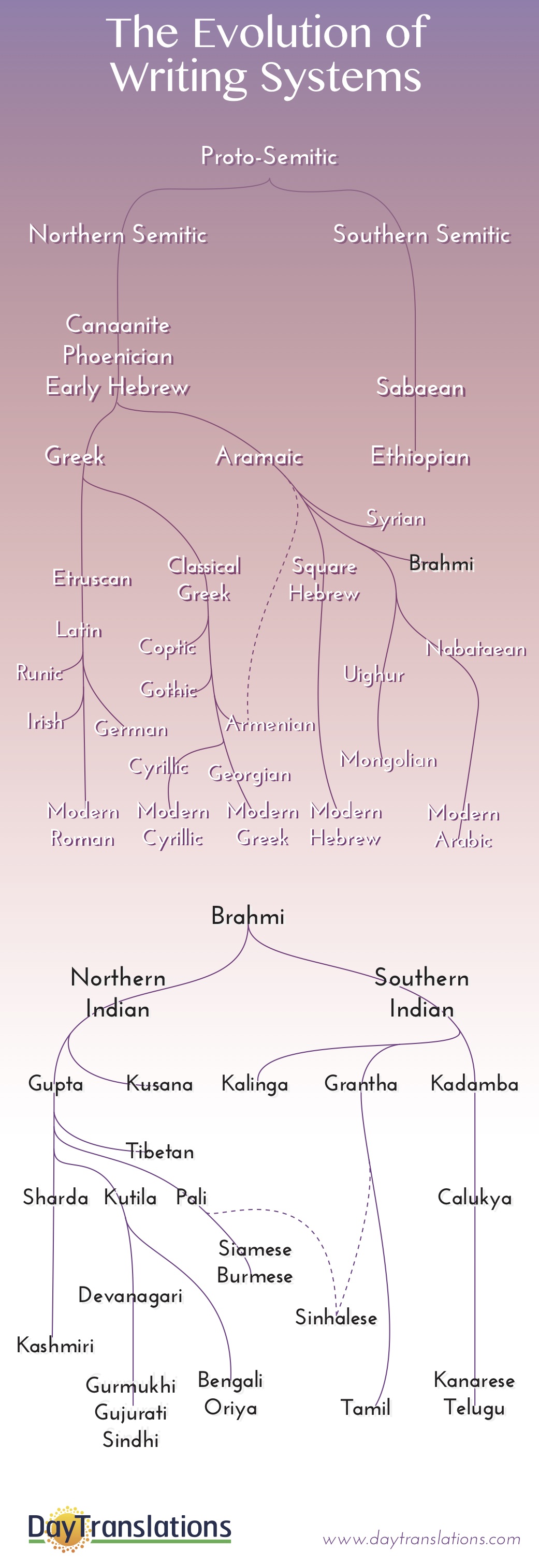
The alphabets of South and Southeast Asia are part of the Brahmic language family. These, too, evolved out of Aramaic. To make sense of this, check out the infographic below, based on work by Dr. C. George Boeree.
Related: Aramaic: An Ancient Language in Danger of Being Lost
Exceptions to the Evolutionary Rule
The exception is Korean Hangeul, the only intentionally created writing system in wide use today.
In Joseon Dynasty Korea, scholars typically used the classical Chinese writing system. But the nation was facing widespread illiteracy, and classical Chinese is notoriously difficult to learn–especially for laypeople and the working class. So in 1443 King Sejeong created the Hangeul alphabet, which is phonetic and deliberately easy to master.
One Confucian elitist said of Hangeul characters “a wise man can acquaint himself with them before the morning is over; a stupid man can learn them in the space of ten days.” He meant it to be derogatory–the academic class was unimpressed by Hangeul’s simplicity. But the writing system caught on, and soon people were reading and writing up a storm.
If you want a taste of how fun and easy Hangeul is to learn, try this on for size:
In Hangeul, the rectangle shape ㅁ is simply an M sound. The vowel ㅐlooks like an H but sounds sort of like the ‘ai’ in ‘hair.’ It’s usually transliterated as ‘ae.’ Similarly, ㄴ looks like the roman L, but it makes a sound like an N.
With that in mind, you can easily transliterate the following syllable: 맨
Got it? It sounds like ‘maen!’ Okay, easy enough. Let’s go a little farther. Add to that ㅎ, which sounds like H, the vowel ㅡ which is similar to the ‘u’ in ‘begun’ and is transliterated as ‘eu,’ and ㅌ which sounds like a T. Now you can transliterate the following word: 맨해튼
Here’s a table to help you:
| ㅁ | M as in ‘mom’ | ㅎ | H as in ‘happy’ |
| ㅐ | Ae, sounds like the vowels in ‘hair’ | ㅌ | T as in ‘turtle’ |
| ㄴ | N as in ‘nice’ | ㅡ | Eu, sounds like the ‘u’ in ‘begun’ |
Did you get it? 맨해튼 is pronounced ‘maen hae teun.’ Manhattan!
As an example of a brilliantly engineered writing system that has stood the test of time, Korean Hangeul is unmatched.
Related: The Korean Language: Beyond K-Pop and K-Drama
An Illiterate Author of a Writing System
Another rare example of an intentionally created writing system is the Cherokee syllabary. Prior to its creation in 1810, the Cherokee language had no system for reading and writing. Sequoyah, the author of the Cherokee syllabary, could not himself read or write in any language.
Nevertheless, he created glyphs visually similar to those in the Greek-Latin and Greek-Cyrillic families. Each glyph represents a syllable instead of a sound.
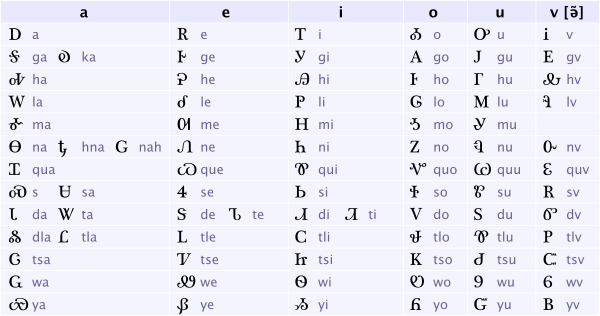
The Cherokee writing system enjoys an increasingly widespread usage today in the Cherokee tribes of Oklahoma and North Carolina.
Not All Writing Systems are Alphabets
Only about a third of global languages today use writing systems. Those are broken up into the following kind of written language:
- Alphabets use characters that represent phonemes (e.g. Latin, Greek)
- Logograms use characters that represent words or phrases (e.g. Chinese)
- Syllabaries use characters that represent syllables (e.g. Cherokee)
- Abjads use characters that represent consonants, and there are no vowels (e.g. Hebrew, Arabic)
- Abugidas use characters that represent consonants, modified with secondary notations to express vowel sounds (e.g. Thai, Khmer)
Related: Arabic Language: Tracing its Roots, Development and Varied Dialects
Here’s a look at the distribution of writing systems in use today:
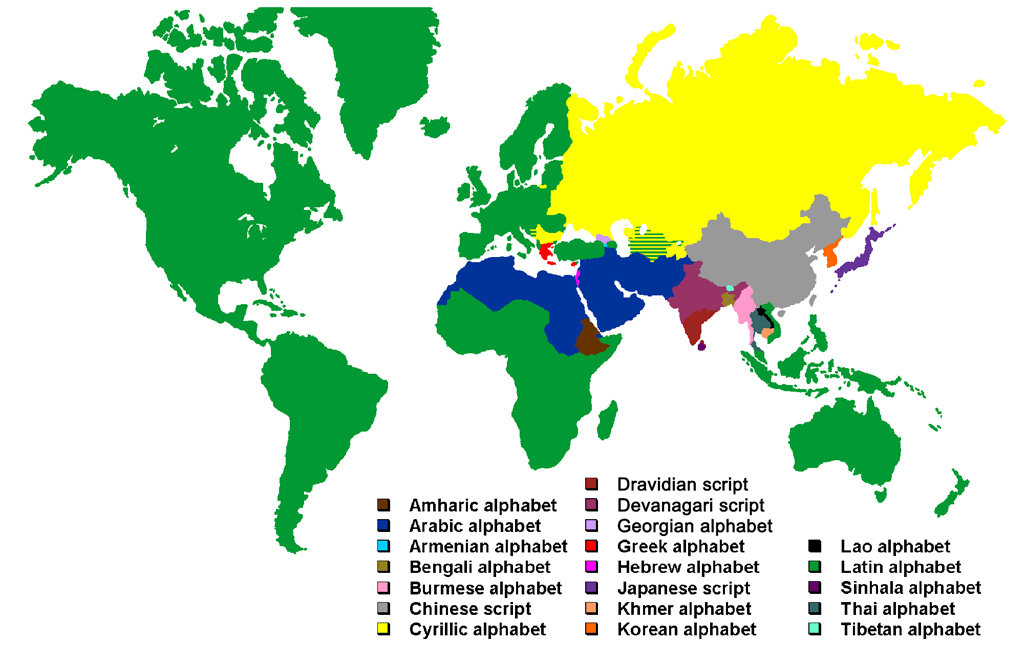
via http://www.worldstandards.eu/alphabets/
Since humans first discovered written language, it’s taken thousands of years to develop into the complex writing systems we have today. Who knows what our writing systems will evolve into in another thousand or four?

Written by
Day TranslationsThe Day Translations editorial team is composed of seasoned linguists, translators, and localization experts with a deep passion for language and cross-cultural communication. With decades of combined experience in translation, interpreting, and multilingual content creation, the team brings a unique perspective on the evolving world of global communication. Their insights reflect both academic expertise in linguistics and hands-on experience. Each article is crafted to inform, inspire, and support professionals navigating the multilingual landscape.
Stay in the loop
Get the latest articles on translation, localization, and language delivered straight to your inbox.