Origins of the Word Villain: From a Farmhand to a Fiend
When you hear the word villain, you probably imagine a sinister figure, maybe a cape-twirling bad guy, a shadowy mob boss, or even a Marvel supervillain. The word drips with menace today. But rewind a thousand years, and villain wasn’t evil at all. It simply…

4 min read
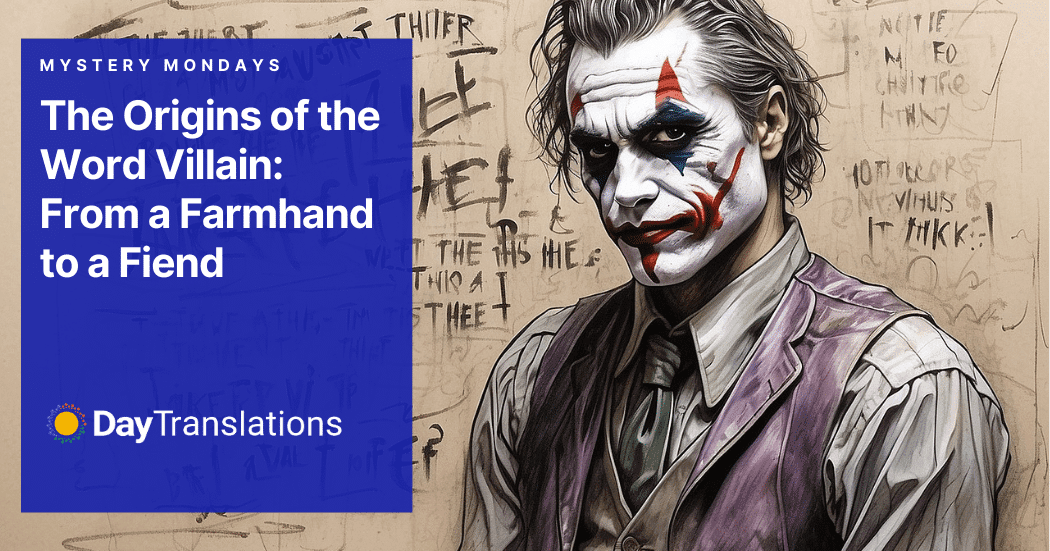
When you hear the word villain, you probably imagine a sinister figure, maybe a cape-twirling bad guy, a shadowy mob boss, or even a Marvel supervillain. The word drips with menace today. But rewind a thousand years, and villain wasn’t evil at all. It simply meant… a farmhand.
That’s right. A villain was the guy mucking out the stables, harvesting crops, or working the soil on someone else’s land. Far from being a criminal mastermind, he was the one least likely to make it into a history book.
Humble Beginnings of the Word Villain
The word comes from Old French vilain, rooted in the Latin villanus, meaning a person attached to a villa or farm. In medieval Europe, a villa wasn’t a holiday home on the coast. It was a country estate, and a villanus was the laborer tied to it.
By the 12th century, when Norman French heavily influenced English, villain entered the language as a simple occupational term. If you worked the land, you were a villain.
No crime. No malice. Just dirt under your fingernails.
From Soil to Shame
So how did a hardworking farmer’s title get twisted into the ultimate insult?
Medieval society was rigidly stratified. Nobles, knights, clergy, merchants, and artisans all held higher social standing than peasants. Those bound to the land, serfs and farmhands, were seen as uneducated, coarse, and “low.”
Over time, villain shifted from describing someone’s job to criticizing their character. To call someone a villain was to imply they were:
- Ignorant
- Rude
- Unrefined
This is a classic case of semantic pejoration, a word’s meaning sliding downhill from neutral to negative. Just as “churl” (originally meaning “free man”) devolved into “rude person,” villain soured from farm worker to undesirable.
The Word Villain Crossing into Criminality
By the 14th century, the insult sharpened further. A villain wasn’t just socially low, it was morally low. The word began to mean someone dishonorable, unscrupulous, or wicked.
Literature fueled the fire. In medieval romances and ballads, the “villain” wasn’t the noble knight or fair maiden. He was the treacherous, brutish figure standing in their way. Language cemented the idea: villain = bad guy.
By Shakespeare’s time, villain was one of the Bard’s favorite insults. He hurled it in Hamlet, Othello, King Lear, and nearly every play with a quarrel. To be called a villain was to be branded base and contemptible.
From Shakespeare to Supervillains
The 18th and 19th centuries solidified villain as a literary trope. In Gothic novels, melodramas, and early detective stories, the villain became a stock character, the schemer plotting in the shadows, the mustache-twirler tying maidens to railway tracks, the foil to the hero.
Hollywood later embraced the term wholeheartedly. The cowboy had his outlaw villain. Batman had the Joker. James Bond had a whole parade of megalomaniacal villains bent on world domination.
Today, the word’s farmhand origins are all but forgotten. To most of us, a villain is synonymous with evil.
Villains in Language and Culture
The journey of villain shows how society shapes words:
- Class prejudice turned a neutral label into an insult.
- Literary drama twisted it further into “evil person.”
- Pop culture polished it into a permanent archetype.
Interestingly, villain isn’t alone. Other words have suffered the same fate:
- Peasant (once neutral, now often dismissive)
- Rustic (from country dweller to unsophisticated)
- Churl (from free man to rude lout)
Our language carries the fingerprints of history’s social hierarchies.
Villainy Today
Nowadays, villain isn’t always serious. We use it playfully:
- “The chocolate villain who ate the last brownie.”
- “Disney villains are cooler than the heroes.”
- “She’s the villain era version of herself.”
That last example is especially telling. TikTok and Instagram have reinvented “villain” into a badge of independence. Declaring a villain era means embracing unapologetic confidence, breaking rules, or prioritizing self-care, hardly the medieval meaning.
So once again, villain is evolving, sliding away from darkness toward a more complex, even empowering, role.
Final Thoughts on the Word Villain
From the mud of medieval fields to the glitter of Marvel movies, villain has traveled a long way. Once it meant ploughing fields, now it means plotting evil schemes. Tomorrow? Maybe it’ll mean something else entirely.
Language loves a twist. And villain may just be the most villainous twist of them all.

Written by
Sahay SharmaStay in the loop
Get the latest articles on translation, localization, and language delivered straight to your inbox.