Translation Fails: 12 Worst Menu Translations
Why do we still see so many of the worst menu translations today? By itself, translation is hard work because of the requirements of the document. Menu translation, in particular, is quite difficult since the terminology and the context of menu entries are vastly different…

8 min read
Why do we still see so many of the worst menu translations today? By itself, translation is hard work because of the requirements of the document. Menu translation, in particular, is quite difficult since the terminology and the context of menu entries are vastly different when they have to be translated into other languages.
Because tourism is growing, restaurants used to serving locals now have to cater to different nationalities, necessitating that their menus should be available in at least another language that would be understood by the majority of foreign visitors – English.
However, even if English is considered a universal language, you cannot expect that the other cultures have knowledge of it or even speak it.
Some reasons why mistranslation of menus happen
You might expect that chefs who have limited English language skills and restaurant managers are to blame for some of the worst menu translations. But even fluent translators will find menus and local food items and ingredients a challenge to their translation skills.
- Unfamiliarity with culinary terms is one reason why mistranslations happen. Other mistakes happen due to the differences in ideograph languages such as Japanese, Chinese and Korean and languages that are alphabet-based like English.
- In most cases, menus are translated by people who are not professional translators, which compound the issue. It can be particularly difficult for restaurants that change their menu offerings daily. Some are typographical errors that pass reviewers, such as food with ”Human taste” instead of ”Hunan”
- Aside from those already mentioned, another reason why we see some menus that are badly translated is because the restaurant tries to provide an explanation or description of an item that does not actually have any equivalent in English, and even one that comes close enough is not sufficient to explain the dish.
- Related to the above is the fact that there are food terms that have cultural associations. For example, there is a dish in Cuba called ropa vieja, which is defined as shredded beef but when translated literally means old clothes.
- Overall, menu translations become very difficult because there is no standard when it comes to translating food, as it has cultural and emotional associations and meanings as well. In some countries, they love drinking or eating something bitter, but in some cultures, declaring that something is bitter could be interpreted as an insult. Moreover, it is not easy to come up with a concise description of a food item in the space available in a menu sheet.
So, a professional translator should make discretionary decisions. If there is no translation available in another language, it might be best to leave things as they are which give the translation an air of exclusivity and authenticity. Sometimes, the intention is to discriminate rather than to enlighten. When you see French or Italian entries in a translated menu, it gives off a sense of exclusivity, of being an insider. If the translation is done right, even foreign sounding terms like ceviche, kimchi, sashimi, soufflé, aioli, antipasto, bisque, bordelaise sauce, bouillabaisse and more are understood by diners.
Some menu items are a mouthful even for locals. So a menu translator should exercise his/her creativity and shape the cultural nuance of the original terms into something that will delight and enchant foreigners.
Just a few of the worst menu translations
Given the reasons why some menus end up being badly translated, here are a few examples of some of the worst menu translations foreigners find and share.
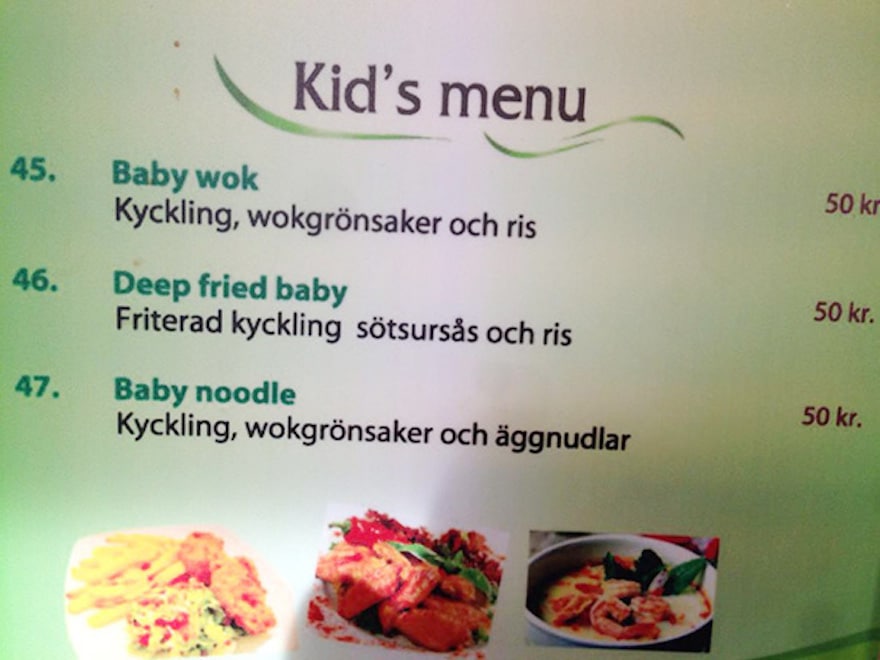
In a Swiss restaurant menu, one of the special offerings under the Kid’s Menu is “Friterad kyckling sötsur sås och ris” that wastranslatedas Deep Fried Baby. Now, who would in their right mind, eat a deep fried baby? The actual translation of this particular menu entry should be “Fried chicken (in) sweet sour sauce and rice,” which is not only logical but sounds delish.
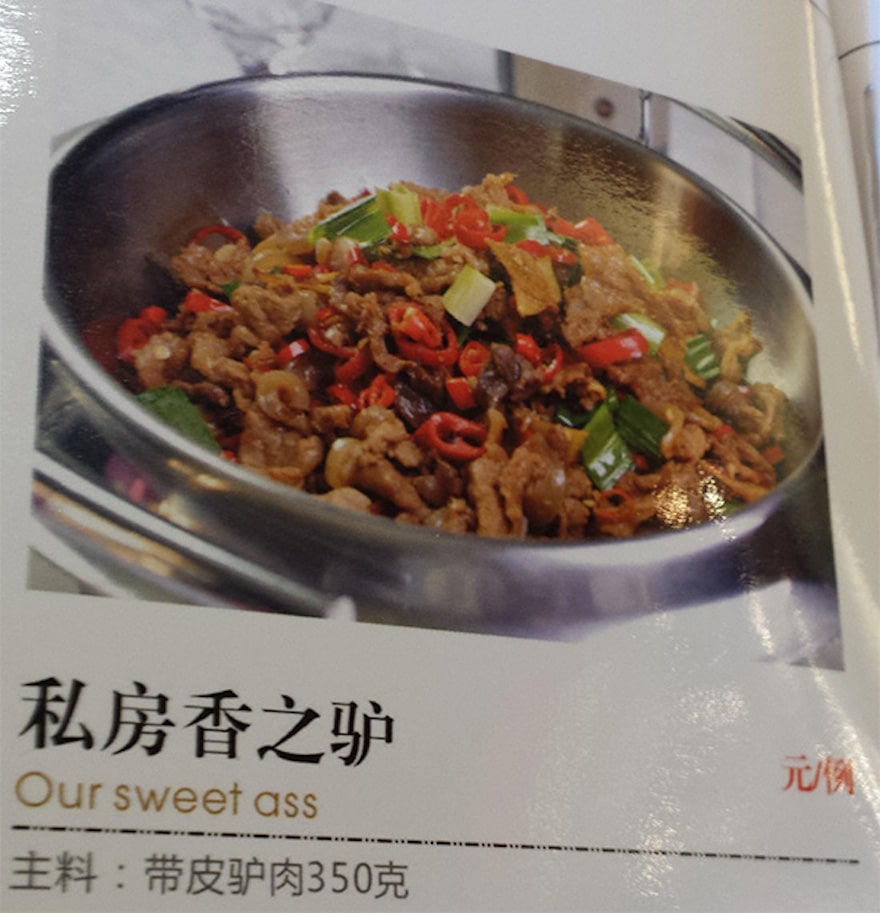
In some countries, “chicken ass” is eaten, served in different ways, including adobo, barbecue or grilled. Actually, it is not the fowl’s ass, but the fleshy part of the chicken’s tail where the tail feathers are attached. But would you eat your own ass like in this menu from a restaurant in China? The translation says “Our Sweet Ass” although the image seems to be that of stir-fried noodles with vegetables and probably some shrimps and chicken meat, including some chicken innards like liver and heart. In the Philippines, it can be one version of the Chinese Lo Mien, “Pancit Canton.” Pancit is derived from pian i sit, a Hokkien term that means ‘convenient food.’ Canton is a type of dried wheat flour noodles (flour sticks).
Here’s a funny menu translation from Spain. If you haven’t tried Rueda de ahumados, you should. It’s a delicious Spanish treat and very popular among Spaniards. In English, it means a selection of smoked canapés served on a platter or tray. But, the sad thing is the translation somehow removed the deliciousness of this treat. Who would think that the translator would translate it into “It rotates of smokey.” Ugh!
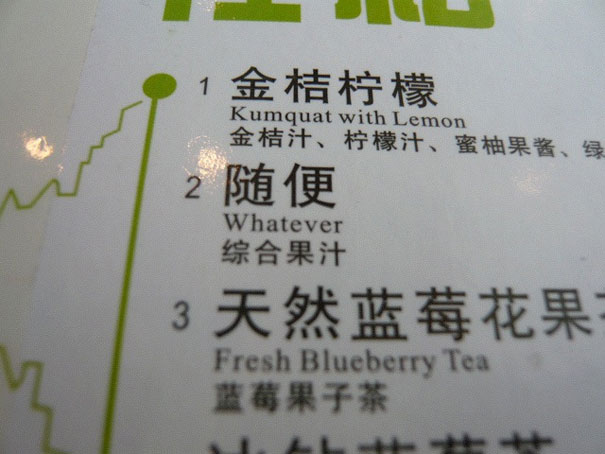
Have you ever experienced a situation when you’re with friends and you cannot decide what to eat or drink and just say, ”Whatever?” Well, you’re in luck because, in a Chinese restaurant, one of the drinks they offer is called Whatever. Do you have the guts to order it, even if you don’t know whatever is in that drink?
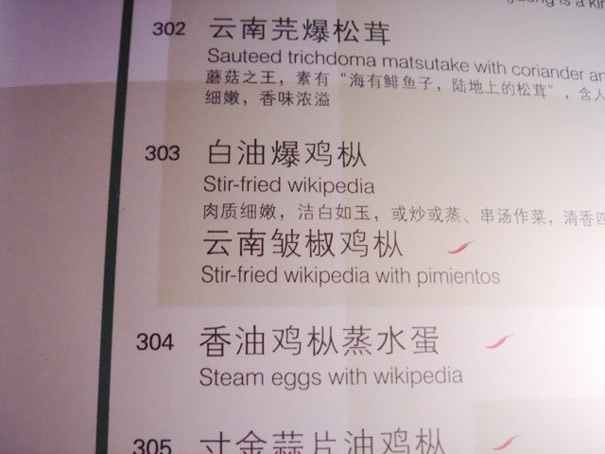
- Did you know that there are menu entries for Wikipedia? Trust the Chinese to do something extraordinary – at least in menu translations. In a Chinese menu, these entries were found:
- Stir-fried Wikipedia
- Stir-fried Wikipedia with pimientos
- Steamed eggs with Wikipedia
If you don’t speak or read Chinese, it is impossible to understand what the menu items mean. Are you brave enough to order a serving of Wikipedia? We certainly don’t!
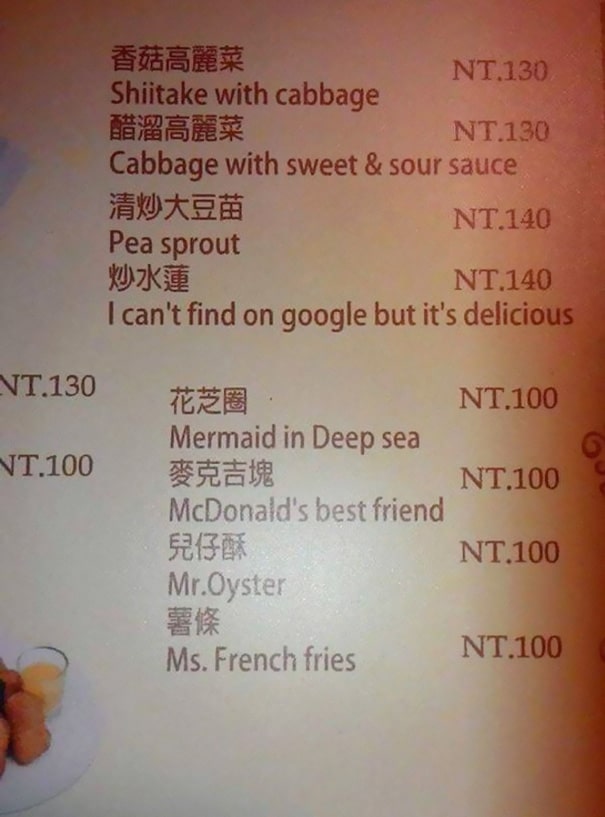
- An entry blames Google as well. Aside from the suspicious entries like:
- Mermaid in Deep Sea
- McDonald’s Best Friend (do you know who he or she is?)
- Oyster
- French Fries
The menu item in question does not have a name or a translation, because it says I can’t find on Google but it’s delicious. At least the translator qualifies that it is delicious.
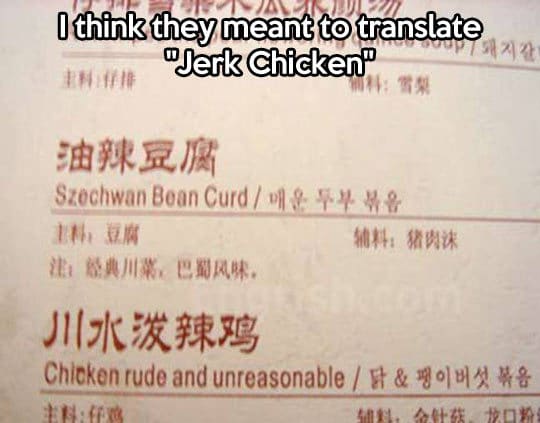
- In another menu, the choices for Fried Rice include chicken and real chicken. What is the difference between chicken and real chicken? The price, of course! Fried Rice with Chicken costs 3.70 while the Fried Rice with Real Chicken is pegged at 6.75. That’s what you’ll get for the mere difference of 3.05.
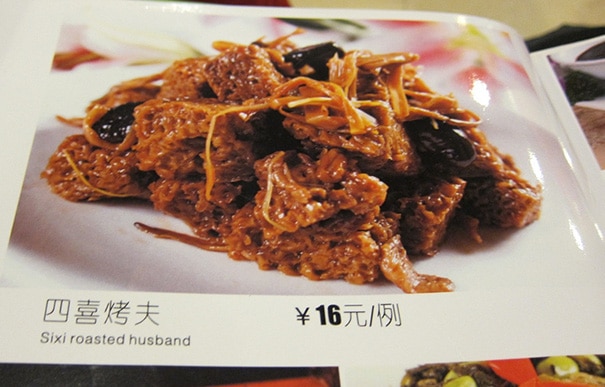
- We understand many women wish to have a sexy husband. But in this Chinese menu entry, you might think twice about your wish. The menu says, Sixi Roasted Husband. Wanna give it a try? It only costs 16 yuan.
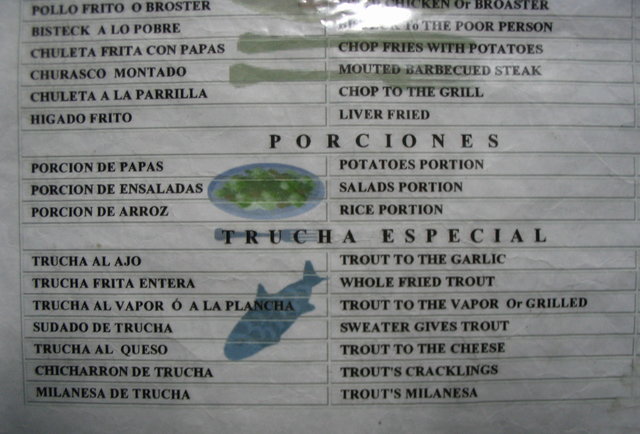
- This particular menu gives translations of their entries in English. Well, at least they tried, because they still failed. Under the Trucha Especial (Trout Specials) is Sudado de Trucha. Trucha is trout and Sudado means sweaty. But in this case, it means stewed. The English translation provided is Sweater Gives Trout. Hmmm, the trout gives diners sweaters or is the trout feeling cold after all that sweat?
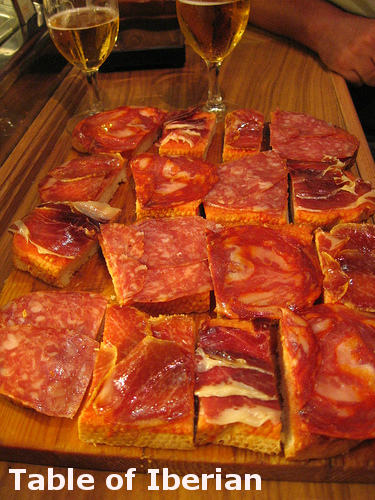
- Spain is known for its wonderful food. But they would not be serving Iberians or tables for anyone, would they? In one menu, Tabla de Ibéricos, which is a selection of various cold meats, was literally translated into Table of Iberian. That must be tough!
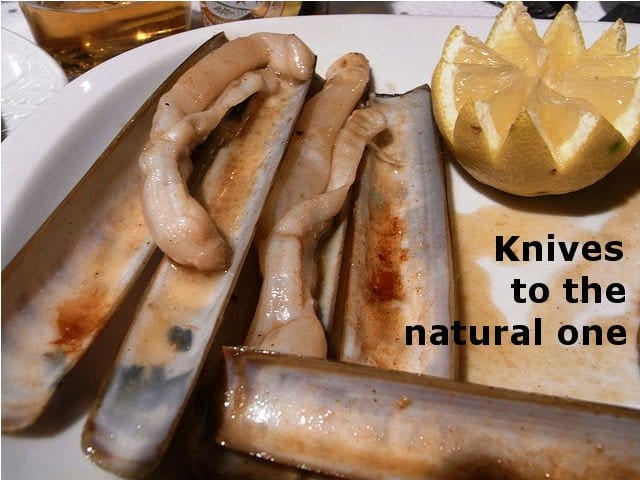
- Seafood lovers may have come across different types of clams and other bivalves that are delicious even if only cooked in their own juice. In a Spanish restaurant, the dish called Navajas al natural means Razor clams cooked in their own sauce. Somehow, whoever translated it named it Knives to the natural one. Go figure…
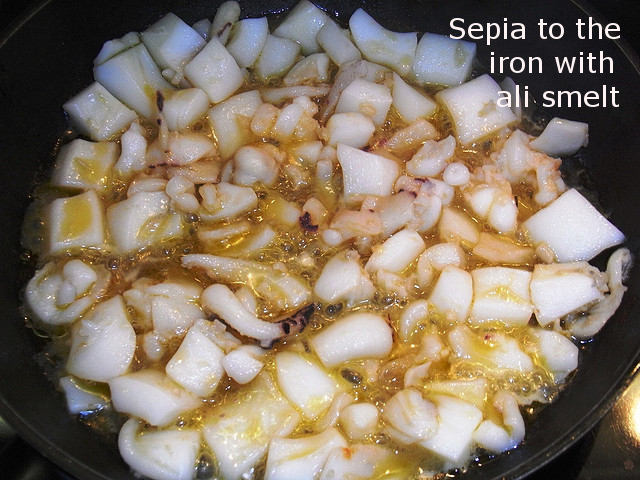
- This is still another menu item from a Spanish restaurant that suffered from a literal translation that took away the scrumptiousness of the dish. Sepia a la plancha con alioli became Sepia to the iron with ali smelt. The actual translation should be ”Grilled cuttlefish with garlic mayonnaise.” Looks yummy. But the translator took things literally as sepia is the cuttlefish; a la plancha became ”to the iron” and ali smelt referred to the sauce.
This list is just a taste of the worst menu translations travelers found. If you are interested to have a good laugh, you can find other mistranslations here.
We do what’s best and appropriate
We understand that menu translations in any language can be tricky as it is difficult to find the right terms from one language to another. At Day Translations, Inc. we strive to provide you with the most accurate menu translations you can find, in more than 100 languages. We are always ready for the challenge. We have professional subject matter experts who have knowledge of the ingredients from the region, cooking methods and terminology. They decide when to do contextual translations or leave the term as it is when it’s appropriate.
Our translators are native speakers and located in-country, meaning they deeply understand local culture and the nuances of the language. Leave your menu translations to our experts and rest assured that your clients would fully appreciate and understand your menu offerings. You can reach us anytime, as we are open 24/7, every day of the year. Reach us at 1-800-969-6853 or send us an email at Contact us, whichever way is convenient for you. Our customer service representatives are always ready to help you.

Written by
Day TranslationsThe Day Translations editorial team is composed of seasoned linguists, translators, and localization experts with a deep passion for language and cross-cultural communication. With decades of combined experience in translation, interpreting, and multilingual content creation, the team brings a unique perspective on the evolving world of global communication. Their insights reflect both academic expertise in linguistics and hands-on experience. Each article is crafted to inform, inspire, and support professionals navigating the multilingual landscape.
Stay in the loop
Get the latest articles on translation, localization, and language delivered straight to your inbox.