Jedek: A Newly Documented Language in Kelantan
The Swedish linguistic team from Sweden’s Lund University that studied the Jahai language that is spoken by a small community in the Malay Peninsula also documented a previously unknown language called Jedek. Jedek is spoken by 280 individuals, who call themselves as ethnic Batek or…

8 min read
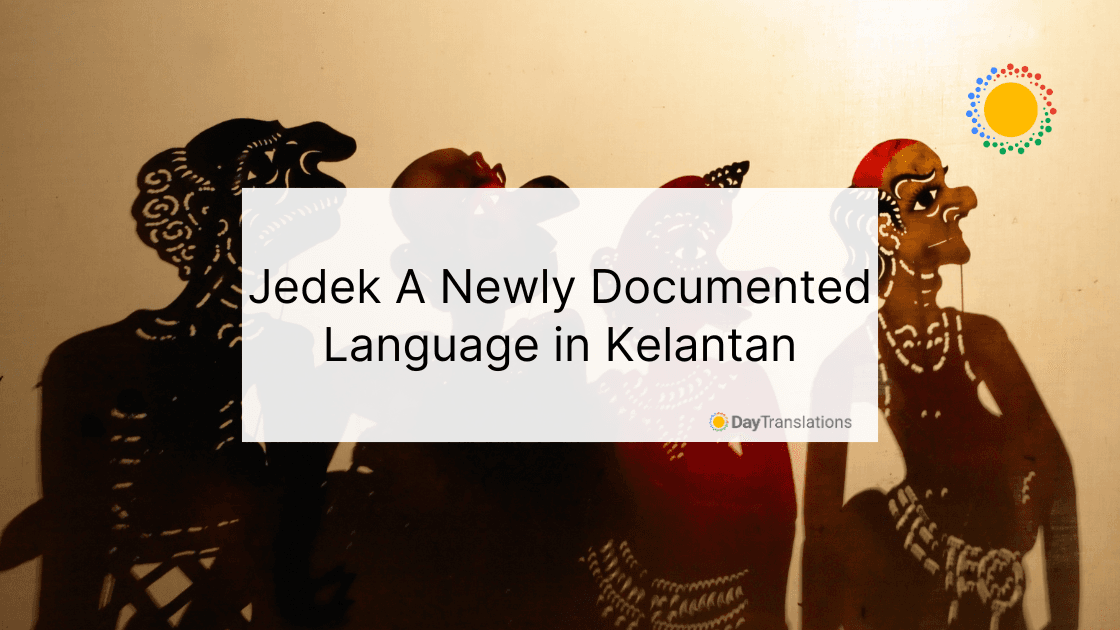
The Swedish linguistic team from Sweden’s Lund University that studied the Jahai language that is spoken by a small community in the Malay Peninsula also documented a previously unknown language called Jedek.
Jedek is spoken by 280 individuals, who call themselves as ethnic Batek or Menriq. The language is quite distinct from the other languages belonging to the Aslian branch of the Austroasiatic languages used in Peninsular Malaysia. Malaysia recognizes several Aslian
Languages, including Temoq, Semelai, Semaq Beri, Mah Meri, Jah Hut, Semai, Temia, Lanoh, Cheq Wong, Batek, Minriq, Jahai, Kintaq and Kensiu. All of the languages belonging to the Aslian branch are under risk of getting extinct.
The tribe speaking Jedek is not unknown. The village where they dwell was studied previously by anthropologists. Lund University Associate Professor of General Linguistics, Niclas Burenhult, said that they were able the collect linguistic materials from the speakers for the first time.
Language distribution
The Jedek speakers live in Sungai Rual. The village is located near the town of Jeli in the state of Kelantan in the Malay Peninsula. They live near the area inhabited by the Jahai speakers. The Jedek speakers used to be hunter-gatherers who have now settled in the village.
Discovery
The linguists were doing research for a project on language documentation entitled, “Tongues of the Semang.” Their research took them through several villages. They collected data from the different groups who speak the various Aslian languages, which led them to discover the group that speak a different language at the time that they were studying the Jahai language.
The result of the study is not available to the public but the linguists shared their discovery in a press release published last month.
They noticed that the villagers were using words, grammatical structures and phonemes that were entirely different from Jahai, according to the study’s lead author, Joanne Yager.
She said that she found it remarkable that no one was looking for the language. The anthropologists who studied the villagers previously did not take the time to record the language or did not notice that it was different. Nobody knew that another language existed.
Ms. Yager thinks that Jedek went unnoticed because there was no formal name for the language. They were the ones that gave it the name Jedek, which they took from the terms the speakers use in common.
The researchers were surprised by the existence of the language that passed under the radar of other researchers. It has words that were distinctly different from the languages spoken in the neighboring villages. However, the linguists are familiar with some of the words that are similar to languages that are spoken in the more remote areas of southern Thailand and Malaysia.
Characteristics of the Jedek speakers
The researchers realized that the community near the area where the Jahai speakers dwell speaks a language that is entirely different to Jahai.
Aside from noticing that the language is different, the researchers found that there is more gender equality in the village of the Jedek speakers. There are no courts or laws. The parents encourage their children not to compete with each other. Interpersonal violence is not existent in the village.
Their skills are fitted to their life as hunters-gatherers, thus there are no members who are engaged in any profession. They found that the Jedek language reflects the way of life of the Batek villagers. The language does not include words for courts of law or occupations. There are no verbs that describe selling, buying, stealing and borrowing. Jedek still has a rich vocabulary, with many of them pertaining to sharing and exchanging.
You can listen how the Jedek language sounds in this video:
According to Professor Burenhult, studying undocumented and endangered languages helps the public learn that there are more cultural riches that are still waiting to be discovered. It also one way to learn that there are more different ways for people to be human, other than the modern society that have become the universal yardstick.
Jedek is not yet included in the list of languages in the latest edition of Ethnologue. But unlike some of the already endangered Aslian languages, Jedek shows no sign of endangerment. This is because it has always been a small language that is spoken by a small community just like the other minority languages. They found that the children are learning the language which shows a better future for it. They also foresee that it will grow since the group is mobile, which means that some other people will be able to learn Jedek through interaction.
Discovery of new languages
In recent history, several new words were discovered. Jedek was discovered in 2017. In 2013, an indigenous sign language that existed back in the 1800s was identified by University of Hawai’i researchers. The sign language was different from the American Sign Language (ASL).
In 2008, Indian researchers who were doing research on other languages, just like the researchers from Lund University, discovered the language that was given the name,
Aka Koro, a threatened language spoken by 1,500, according to Ethnologue. Aka Koro speakers are located in East Kameng district at Arunachal Pradesh state. It does not have a written form.
Australian linguists discovered the language that is called Light Warlpiri, which was spoken by 350 residents inhabiting the town of Lajamanu in Australia’s Northern Territory. According to Ethnologue, the language is developing. It is a combination of Standard Australian English and two indigenous languages, Kriol and Warlpiri.
The life of a language
It is not surprising that there are still more languages out there that are not yet documented. But what is disheartening is that most of them are already threatened before they are discovered. Moreover, many more languages are becoming extinct because the last speakers died. Many more are projected to die.
According to Professor of Linguistics teaching at Swarthmore College, K. David Harrison, at least two languages die every week. He said that a large quantity of human knowledge dies with the language. The death of a language means that the personal histories, the creation of myths, means of survival and making of herbal medicines are gone.
The professor, who is also a fellow on National Geographic, added that the decision to give up a person’s language depends upon the existence of a more dominant group, by the country’s educational system, by the market and by politics.
Recent revival of other languages
Although a number of languages become extinct, there are other developments. Several languages that were presumed to be extinct or almost extinct have been revived recently. Hebrew is an example of a success story of revival.
While the other revived languages are still unstable, just the fact that they are enjoying a revival is already good news. Some of them include the following:
- Ainu is spoken by the indigenous group living in northern Japan. Since the 1920s, it was already in the ”dying language” status. In 2006, only about 4.6% of Ainu speakers in Hokkaido are able to speak the language. This could be because the language is not taught in elementary and high school but offered at universities and language centers in Hokkaido. Researcher Kayano Shigeru is in the forefront of the revival of the language. He recorded the oral epics or ”yukar” and established Japan’s first Ainu language school.
- Barngarla is an indigenous language spoken by the Aborigines living in Eyre Peninsula located in South Australia. Professor Ghil’ad Zuckermann of Adelaide University spearheads the revival of the language. They are reclaiming the language based on documents that are 170 years old. The group released a mobile app in 2016. It has a dictionary containing more than 3,000 words.
- In California, the Muwekma Ohlone Tribe is reviving the Chochenyo It is also called the East Bay Costanoan or the Chocheño language. They are creating the Chochenyo dictionary. Their database has about 2,000 words in 2004. In 2009, many of the students of the language were able to carry regular conversations. A Muwekma Ohlone tribal member, Vincent Medina, read the first reading in the language when Saint Junípero Serra was canonized in 2015.
- Another Australian Aboriginal language that is being revived is Kaurna, which is spoken by the Kaurna tribe in Adelaide, South Australia. Since 1931, the language was extinct as a first language. Efforts to revive it are headed by a group of linguists, researchers and teachers together with elders and youth of the Kaurna tribe. They are called the Kaurna Warra Pintyandi and holding their headquarters at Adelaide University. The group started the revival of the language in the 1990s.
- In 2006, UNESCO declared that Leonese is seriously endangered. Leonese is spoken in León and Castile in Spain. The language is enjoying massive support from the government of the Province of León. The government also sponsors literary efforts and some of its bureaus use the language. They have the Leonese Language Day since 2007 and language courses for adults have been established. Schools now teach the language and the official website of the government of León is in Leonese.
Day Translations, Inc. uses human translators to accurately translate documents from and into Malay and other Asian languages. Contact us through email at contact@daytranslations.com or call us at 1-800-969-6853 any time of the day, wherever you are. We operate 24 hours a day, 7 days a week throughout the year, to provide clients with high quality language services. For mobile phone and tablet users, you can download Terpy, our app to quickly connect to Day Translations. The app is available from iTunes and Google Play.

Written by
Day TranslationsThe Day Translations editorial team is composed of seasoned linguists, translators, and localization experts with a deep passion for language and cross-cultural communication. With decades of combined experience in translation, interpreting, and multilingual content creation, the team brings a unique perspective on the evolving world of global communication. Their insights reflect both academic expertise in linguistics and hands-on experience. Each article is crafted to inform, inspire, and support professionals navigating the multilingual landscape.
Stay in the loop
Get the latest articles on translation, localization, and language delivered straight to your inbox.