10 Japanese Language Fun Facts
Japan is a country with a beautiful culture and colorful traditions. It’s vast, and its unique traditions have made it a dream destination for countless people from all over the world. Japan is steeped in literature, architecture, arts, religion, and language. There are so many…

6 min read
Japan is a country with a beautiful culture and colorful traditions. It’s vast, and its unique traditions have made it a dream destination for countless people from all over the world. Japan is steeped in literature, architecture, arts, religion, and language. There are so many fascinating traditions and cultural history of the Japanese that would astound you and leave you asking for more, and the popular language spoken in our favorite Japanese action movies is high up there on the list. We created this list of the 10 most interesting Japanese language facts so you can impress your colleagues and international friends. Let’s dive in!
1. Japanese Is Pretty Fast
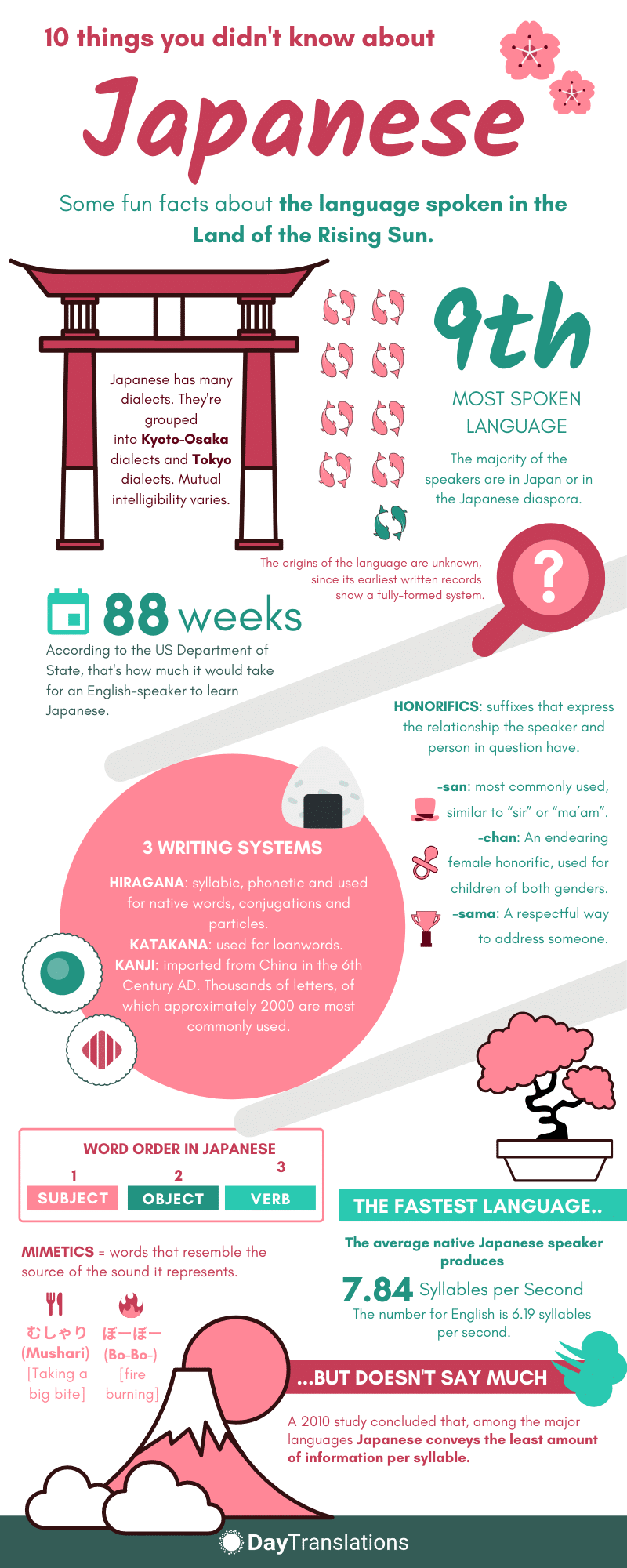
After evaluating translations of the same text in eight different languages (Japanese inclusive) and comparing their syllabic rate (that is the number of syllables per second), information density, and the rate at which information was passed, it was found out that the Japanese language had the highest syllabic rate.
Cross-language comparison of information density, syllabic rate, and information rate (mean values and 95% confidence intervals). Vietnamese is used as an external reference.
On the other hand, it also sports the lowest information density and information rate. This means that the Japanese language uses almost twice as many words to pass the same information as English.
However, this doesn’t mean it’s the slowest language; many phrases which may seem obvious to Japanese natives are omitted, for example, ‘I,’ and some pronouns.
2. There Are So Many ‘I’s
For foreigners speaking the Japanese language, the Japanese word for ‘I’ is ‘Watashi.’ However, for native speakers, ‘I’ can be in various forms. The Japanese really splurged on this one. There over 20 variants, here are just seven of those-
- Watashi (わたし/私): The standard way to say ‘I/me.’ Also used on formal occasions or when speaking to a superior.
- Watakushi (わたくし/私): This is more polite than Watashi. It’s used on official occasions.
- Atashi (あたし): A standard feminine variant of ‘I.’ Used for informal occasions, when speaking to a friend or junior.
- Atakushi (あたくし): It’s a female variant which is more polite than Atashi.
- Washi (わし/儂): It’s used in the Kansai area by older men and women.
- Boku (ぼく/僕): A semi-humble pronoun for young men.
- Ware (われ/我): It is highly formal. Usually used in a speech or meeting. Often used in the plural as ‘wareware’ (我々, we.)
3. Japanese Uses Four Writing Systems
You heard right, four! They are-
- Kanji: They are Chinese letters absorbed into the Japanese lingua. It is made up of over 6000 characters, though the average Japanese may just need 2136 for daily life in Japan (1006 learned in elementary school, and 1130 in junior high and high school)
- Hiragana: This is the most original writing. It is made up of 46 cursive characters used to write Japanese syllables. It is also used for verb and adjective inflections and simple words.
- Katakana: For foreign words, names, and loanwords changed to suit the Japanese tongue, e.g., ‘teburu’ (table, ‘aisu’ (ice), and ‘takushi (taxi).
- Romaji: Sometimes, it’s not counted as a writing system. It evolved from the romanization of Japanese words developed in the 1500s by Japanese Catholics for the European Jesuit missionaries who came to evangelize in their country.
4. Japanese Isn’t Confined To Japan
It is the 9th most commonly spoken language. It is also the official language of Japan ‒ naturally. Actually, it is the only country that has Japanese as its official language, because most speakers of the language reside in Japan. However, Japanese isn’t only spoken in Japan. In the Republic of Palau, it is considered a minority language; Japanese is also spoken amongst residents in Hawaii and California!
5. Verbs Come At The End
Unlike the English Language that makes use of the subject-verb-object- order, the Japanese language uses the subject-object-verb. It does look kind of backward to foreign speakers. Sometimes there is no need to specify the object, and only verbs are used for a full sentence!
6. No Conjugation Of Verbs
‘I see, you saw, they have seen.’ All this isn’t necessary for the Japanese language, because there’s no conjugation of verbs. This unique feature makes the language easier to learn. A beginner needs only to memorize the main verb and move on to the more difficult writing system.
7. There Are No Articles
There is no difference between ‘an,’ ‘a,’ and ‘the’ in Japanese. This makes learning Japanese easier for foreigners, but a bit complicated for Japanese speakers learning English.
8. It Is Actually ‘Nihongo’
While most people outside Japan refer to the language as ‘Japanese,’ native speakers actually call it ‘Nihongo.’ This is the same with the name ‘Japan,’ which is referred to as ‘Nihon’ or ‘Nippon’ in the native dialect. The reason why it’s called ‘Japan’ by other countries is that early Portuguese explorers in China heard the Mandarin pronunciation ‘Cipan’ as ‘Jipangu’ and recorded it so.
9. There Are Different Formality Levels
The people of Japan are big on respect and formality; it even shows in their language. There are three primary polite forms in spoken Japanese: the plain form (‘kudaketa’), the simple, polite form (‘teinei’), and the advanced polite form (‘keigo’). Japanese also makes use of honorifics by adding suffixes to words to show various degrees of respect.
10. It Can Be Written In Two Ways
The Japanese language is traditionally written vertically and read from top-bottom, but it can also be written ‘normally’ in a horizontal manner and read from left-right. Some newspapers even join the two methods to maximize paper space. It may seem like a jumble to you, but it’s really not.
It’s a lot to take in, we know. It looks challenging‒yes, a little. Still, if you really put your mind to it, you can learn enough Japanese to be able to haggle over Koi in a bustling Japanese market or trash that opponent in an online game. When it comes to matters of higher importance, such as business meetings with potential international partners, or the translation of your marketing material for your foreign clients, we recommend hiring an experienced Japanese translation company. Either way, we wish you luck!

Written by
Day TranslationsThe Day Translations editorial team is composed of seasoned linguists, translators, and localization experts with a deep passion for language and cross-cultural communication. With decades of combined experience in translation, interpreting, and multilingual content creation, the team brings a unique perspective on the evolving world of global communication. Their insights reflect both academic expertise in linguistics and hands-on experience. Each article is crafted to inform, inspire, and support professionals navigating the multilingual landscape.
Stay in the loop
Get the latest articles on translation, localization, and language delivered straight to your inbox.