If Everything Is a Priority, Then Nothing Is
In the past, workers put a priority on tasks, to ensure that work that should be done first is given all the attention until it is finished. Priority was first used in the 1400s. It’s a singular word that equates to something being the first…

9 min read
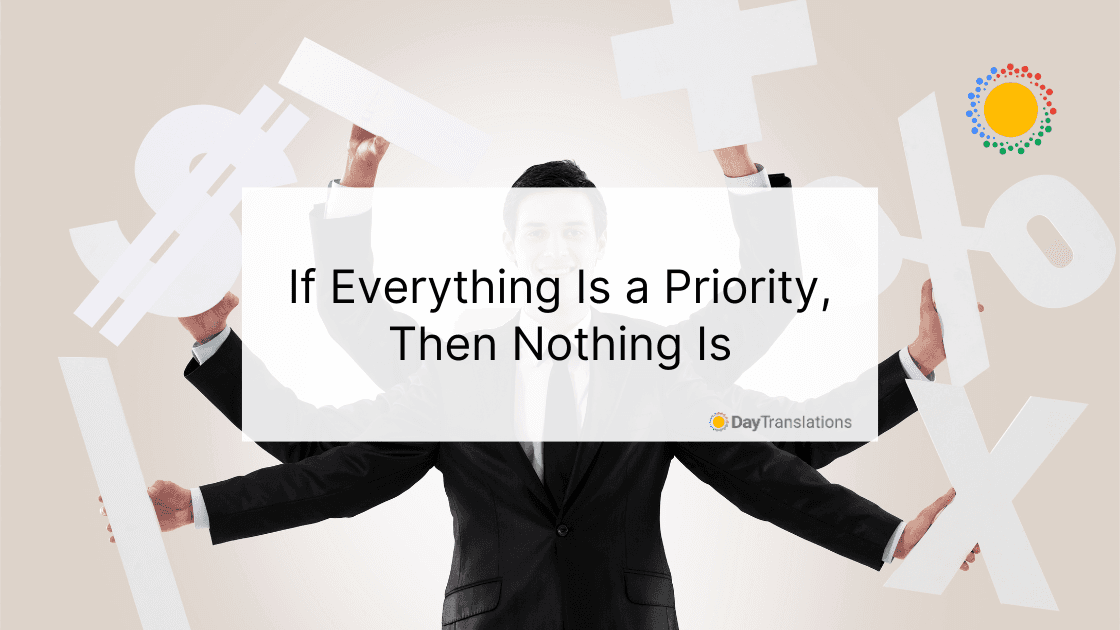
In the past, workers put a priority on tasks, to ensure that work that should be done first is given all the attention until it is finished. Priority was first used in the 1400s. It’s a singular word that equates to something being the first one. It remained as a singular word for five centuries. But in the 1900s, it gained a plural form, so people talked about and used ”priorities.” In this context, you can equate it to several things being ”the first.”
In life and work, people believe they have priorities, in the plural form, which means that each one is a ”first.” So if you consider each item a priority, it negates the real meaning of the term, therefore, nothing becomes a priority.
Today’s modern offices demand so much more from their employees. Productivity tools allow employers to hire fewer people. However, the number of daily tasks that should be performed is not lessened, leading employees to work harder and longer.
In the current office scenario, many people spend most of their time jumping from one task to another, with each task a priority. This leads to the topic of multitasking that many people say they can do. With the office demanding that everything is a priority, multitasking or the ability to do at least two activities or tasks becomes a requirement.
Multitasking
Is multitasking possible or is it just a myth?
There are activities that you can do at the same time. You can listen to the radio or music while you cook, clean the house, do office work or exercise. You can answer a phone call while typing an email.
However, it is difficult to concentrate on two activities at once. Doing things simultaneously forces the brain to quickly move from one activity to another.
So, is multitasking in the office setting possible?
Many studies have been conducted about this. And all the results agree that multitasking is more of a worry than an accomplishment. Results from the studies suggest that people who multitask remember less information and are more prone to mistakes.
A University of London study found that people engaging in multitasking activities pay a mental price as switching from one task to another changes a person’s mental and physical states. This switching back and forth consumes time and resources, thus, affecting the performance of the person. If the interruption is longer, the more it is harder to get back to the original activity.
The mental price, in the world of psychology, is ascribed as switching cost. It is defined as the interruption of the performance when the person has to switch the attention from one activity to the next. It does have a monetary equivalent. In a study conducted by Adobe and published in August 2018 for example, the average person checks work email for about 3.1 hours each workday. So, the office effectively loses 15.5 hours per worker each workweek. That is a lot of productive hours the company loses.
Other studies in the past showed that it takes a person 64 seconds after checking his or her email to resume working on the current task.
And did you know that before human multitasking became a buzzword, the term was used to describe the capabilities of an IBM computer released in 1965? Yes, multitasking is a computer feature.
Establishing priority tasks
Whether you are working from home or in an office, it is best to choose which task takes precedence over other activities. Doing so will help you concentrate on the task and achieve good results.
If you have several tasks lined up for the day or the entire workweek, you’ll achieve more if you learn to prioritize. Identify the task that is the most important and put it on top of your list. Determine the amount of time you need to finish the job, the resources and the dependencies (things you need from your co-workers to complete the task). You have to decide whether you need the entire day to finish the task or you have other tasks to complete for the day. Just remember that while you can postpone other tasks, working on your priority task should be done.
Choosing your priority tasks by order of importance is better than multitasking, which lets you start every job you have for the day or the week. If you notice, you are not accomplishing much by multitasking because you cannot concentrate on a specific task.
When you prioritize, you develop a better work habit because it forces you to be organized and responsible. Your priority task is your anchor task for the day or the week, and even if things at work become disorganized, you know what you must do because you have already identified what is the most important and urgent.
Are you busy and overworked?
You’ll be in such a state of being busy and overworked if you are a multitasker. Does this make you important? Are you contributing more to the company?
You might be too busy because you are trying to do too many things at once. But are you doing enough for the company? In your effort to do several tasks during the day, consider how many you are able to complete. If you are not completing anything, it might be time for you to learn which of the tasks assigned to you is the top priority.
When you learn to do so, you’ll be able to concentrate on it and finish it on time. You would not be wasting work hours. Your stress level will be lower. You can give your brain a rest and be ready for the next priority task. You will be a more effective and productive employee.
Attaining success in multitasking
While multitasking is generally not an efficient way to work, you can still make it work, which will turn you into a better employee without feeling burned out and stressed.
Does it sound complicated? It’s not, as long as you learn how to manage your multitasking activities by assigning priorities.
Over the past decade, many companies had to downsize, which increased the workload of the employees that were retained. Thus, these workers were forced to multitask. But multitasking is not effective over the long term, because it makes the workers work harder, leading to higher levels of work-related stress.
What people should understand is that multitasking is a skill that should be learned. If a person knows how to efficiently manage multitasking, it can lead to increased productivity and reduced stress. It can make people enjoy their work.
Here’s how you can do it.
- Master the skill through practice. When you constantly practice an activity, you master it and it becomes routine. So pick a few of the routine tasks you have and establish a schedule on how to do them. Determine the amount of time it takes for you to learn them, which is essential. You have to give yourself time to learn a new task or take on a new responsibility. You can be more efficient once you have given your brain and your body the time to reach your desired productivity level.
- Manage your multitasking by setting priorities. You already know that your memory recall is reduced by the constant switching of your brain between tasks. You can liken it to a computer with too many windows open. When you need to pull up a document from another application, your computer might freeze due to insufficient memory. The same happens to your brain. If the tasks you’re working on need concentration, your brain overloads. Your brain can process information from one activity at a time, so if you need to fully concentrate on one task, it is better to set priorities. Once it’s complete, you can move on to other routine tasks that do not need full concentration. Managing your multitasking activities reduces or removes the risk of making mistakes.
- Use references to boost your skills in multitasking. At work, you often have items that you refer to frequently, such as keyboard shortcuts, pricing information, shipping details and other necessary data to complete your work. Instead of memorizing them, make a list and put it near your computer or phone, You minimize the time it will take to look for these information and at the same time you do not tax your brain on small details.
- Cycle between single tasking and multitasking. You can prevent burnouts by letting your mind reboot during your workday. You are more productive if you rest and give yourself time to replenish your energy. Your brain needs the same thing. So after working on multiple tasks nonstop for three hours, stop and work on a single thing for about half an hour. You’ll feel that you are more alert and ready to work once again after the brief rest.
- Allow your brain to take a break. As an employee, you are entitled to two 15-minute breaks and a one-hour lunch break. You should take advantage of these breaks to relieve stress and rest your brain. You can meditate, close your eyes and let your mind wander, walk around your building or simply sit outside your office when the weather permits. Even if it is a brief break, you’ll feel your energy coming back.
Although multitasking is important today, it is vital for you to learn how to manage the skill and know which tasks should be given priority if you want to accomplish more. It will help you differentiate between an overworked employee and a productive employee. Remember that if you prioritize every task, you’ll end up not completing anything.
We prioritize every project because we can
At Day Translations, Inc. our translators do not multitask. We employ staff to work on each specific process of the translation project. But we assure you that each translation work we do is a priority because we understand the urgency of your need. We have thousands of translators located around the world, who can work on your language services requirement in over 100 languages. Whatever time of day, wherever you are, you can get in touch with us at Day Translations by sending us an email at Contact us or calling us at 1-800-969-6853. We are open 24/7, every day of the year.

Written by
Sean Hopwood<a href="https://www.seanhopwood.com/">Sean Hopwood</a> is a lover of languages, peace, progress, education, and positivity. Speaking 6 languages, English, Spanish, French, Arabic, German, Portuguese and Hebrew, he has shown a love of cultures since childhood. He is currently the C.E.O. of Day Translations, Incorporated.
Stay in the loop
Get the latest articles on translation, localization, and language delivered straight to your inbox.