Movie Localization: All You Need to Know
Hey there! This article is part of our full Localization All-in-One guide! Check it out to find out more about the entire process behind international expansion! So, here’s something that even movie lovers could’ve missed. Movies go through a localization process for which their content–script,…

7 min read

Hey there! This article is part of our full Localization All-in-One guide! Check it out to find out more about the entire process behind international expansion!
So, here’s something that even movie lovers could’ve missed. Movies go through a localization process for which their content–script, characters, takes, even colors, and figures–are altered and edited depending on the destination where the movie will be streamed. The research process behind those modifications is crucial to film localization.
Movies deliver messages through symbolisms, metaphors, and even jokes. Therefore, it is no surprise that when it’s time to adapt it for a foreign audience’s consumption, a literal translation of the script would simply not do. Movies are not just about the words being said.
And here’s where things get tricky: how do we convey the deeper meanings of films to linguistically and culturally-diverse audiences?
Let’s dive into the interesting process of changing a movies’ content depending on the culture of the country where they’re set to be released.
Film localization
When it comes to adapting a movie for a completely different audience, there are several steps that need to be followed so that the message won’t get lost in translation.
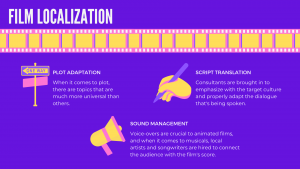
Step One: The Plot
Storylines that achieve worldwide success are those that don’t get caught up in specifics. Let’s think about movies that are shot in high school scenarios. High schools are not the same everywhere. American schools might not be like Latin American schools, or Europeans, not to mention Asian schools.
Instead, some topics are universal. There are plots that include adversities that would be interpreted as a problem by any culture because they’re tied up to human nature. Following a hero’s journey, the struggle between goodness and evil, a forbidden love… anyone in the world could empathize with at least one of these topics.
Now a comedic plot is a lot more complicated to export. See, humor is not the same everywhere, especially when the comic references have some sort of linguistic double meaning. Playing with words is smart, but it will limit the number of people from other countries that can follow up.
Text adaptation
Once the content of the movie has passed the “universality” test, words come next. Your literal words. The written content and script of the movie. Achieving comprehension of the narrative is crucial, and it can be very challenging to prepare.
The character will be brought to life according to the script, which is why it’s important to count with a consultant that will best know how do adapt the narrative to the target country. Imagine an archetype not being understood by the audience because the references included were too specific. Making a movie is also making history, and that history has to be told and understood in more than one language.
Sound Management
For movies that include the possibility of subtitles, the sound editing process might not be too demanding. But for animated films, it’s essential. Kids are generally not too enthusiastic about the idea of spending the whole movie reading subtitles. Part of the fun is to be guided by the images and sounds.
In this case, sound management and professional movie voice overs are a very important step in the localization process since the movie has the same amount of minutes available to include a different number of words because what can be said in a language with three words, might take two whole sentences in another. Certain references can only be understood by the youngest audiences if they’re very clear.
Language Adaptation > Script Translation
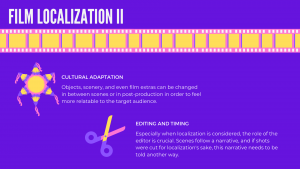
Let’s consider that even if the audience understands what’s being said, it might not find it relatable in the slightest. Cultural factors have to be considered as well. Tone of voice, cartography, and pronunciation are also relevant when thinking about giving the audience a realistic context of events.
Sometimes, speaking the same language might involve changing objects, sports, or even animals. A great example of a clever localization strategy is seen in the movie “Zootopia”. In the original movie, an anchor is represented by a moose whereas, in the Chinese adaptation, the same character is represented by a panda, just as it is a koala for Australia.
Learning about the target country is a key element to make sure audiences can relate to what they’re seeing on the screen.
Final cut: Editing and Timing
One risk of the localization process is losing coordination in the way. Scenes have a beginning and an ending. This cannot be altered after the specific details of different countries have been included.
The movie must keep its essence. That’s why the former stages mentioned need to be taken into account first. Evaluating content and plot from a universal perspective will save time later in cutting scenes and excessively editing. For instance, there have been action movies that included love scenes with religious and iconic temples at the back of the scene. Public from those places could take that as disrespectful instead of considering it as an amazing display, and editing those out might interfere with the length of a scene, therefore changing the cohesiveness of the plot.
After all, it is not the same to introduce a hero in a 4-minute fighting scene than in one that only lasts 30 seconds.
Perhaps, some directors might benefit from having a localization consultant directly in the set. This way, before decisions are taken, the goal of localizing the film in the future for a global audience is always considered.
Constant Research
This one is not a final step. Actually, it has to be carried on during the entire process of localization. Not only the initial idea for the script has to be evaluated under a “worldwide” light, but each one of the following steps, too. That means that every line, costume, cast, even soundtrack has to be the result of thorough market research. That is, if the intention is for the movie to be localized for a worldwide audience, and the budget of the film is not so that it can afford to have entire teams working on adapting every piece of the film later.
And yes, we meant the market research part. Running market research will provide insight into consumers’ behavior in the entertainment industry. What do people enjoy watching the most? Who’s my audience and what will they find funny? What’s their economic or even political context today?
It may sound arduous, but it will prove to be helpful and profitable for the future of the movie.
Some fun examples
Believe it or not, Movie Localization has always been right here, in front of our noses without anyone noticing. And how would we? Since we’re talking about different cultures all around the world, people can’t imagine which parts would need adaptation, and which could really have a completely different meaning to others.
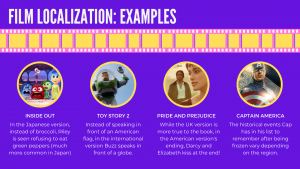
Let’s see some examples of localization in recognized films throughout the world:
- Inside Out: While the original version features Riley’s father feeding her broccoli, the Japanese localized movie shows green peppers, which are much more popular in the country. Additionally, the scene where Riley’s dad daydreams about hockey actually features soccer in the international version, as it is more popular globally.
- Toy story 2: There’s a scene where Buzz Lightyear gives an inspiring speech in front of the American flag. In the international version, the flag is changed for a globe.
- Pride and Prejudice: here, the UK version was more true to the book, ending with the conversation between Lizzie and Mr. Bennet. But for those that were looking for something a little bit more passionate, they were happy to see that the American version has Elizabeth and Mr. Darcy kissing at the end!
- Planes: the sky version of Cars features the character of Rochelle who, depending on the version (Canadian, Brazilian, Australian or Russian) changes its paint. This happens too in some of the Cars movies.
- Captain America: remember Cap’s little to-do-list to remember things after he’s been frozen? The items on that list in each of the 10 different international releases according to popular events of each region.
Crazy, right? There’s a lot more to filmmaking than one can imagine. If you’re in need of reliable movie localization services, count on us to follow each of these steps!

Written by
Day TranslationsThe Day Translations editorial team is composed of seasoned linguists, translators, and localization experts with a deep passion for language and cross-cultural communication. With decades of combined experience in translation, interpreting, and multilingual content creation, the team brings a unique perspective on the evolving world of global communication. Their insights reflect both academic expertise in linguistics and hands-on experience. Each article is crafted to inform, inspire, and support professionals navigating the multilingual landscape.
Stay in the loop
Get the latest articles on translation, localization, and language delivered straight to your inbox.