What is the Gig Economy? Know More about this Buzzword
Freelancing, independent work, and alternative job arrangements are becoming more prominent. They make up the free market system called the gig economy, which is predicted to take over 40% of the US labor landscape by 2020. It’s difficult to ascertain whether or not this trend…

10 min read

Freelancing, independent work, and alternative job arrangements are becoming more prominent. They make up the free market system called the gig economy, which is predicted to take over 40% of the US labor landscape by 2020. It’s difficult to ascertain whether or not this trend will end up dominating economies across the world, but it is surely making noticeable waves.
What is the gig economy?
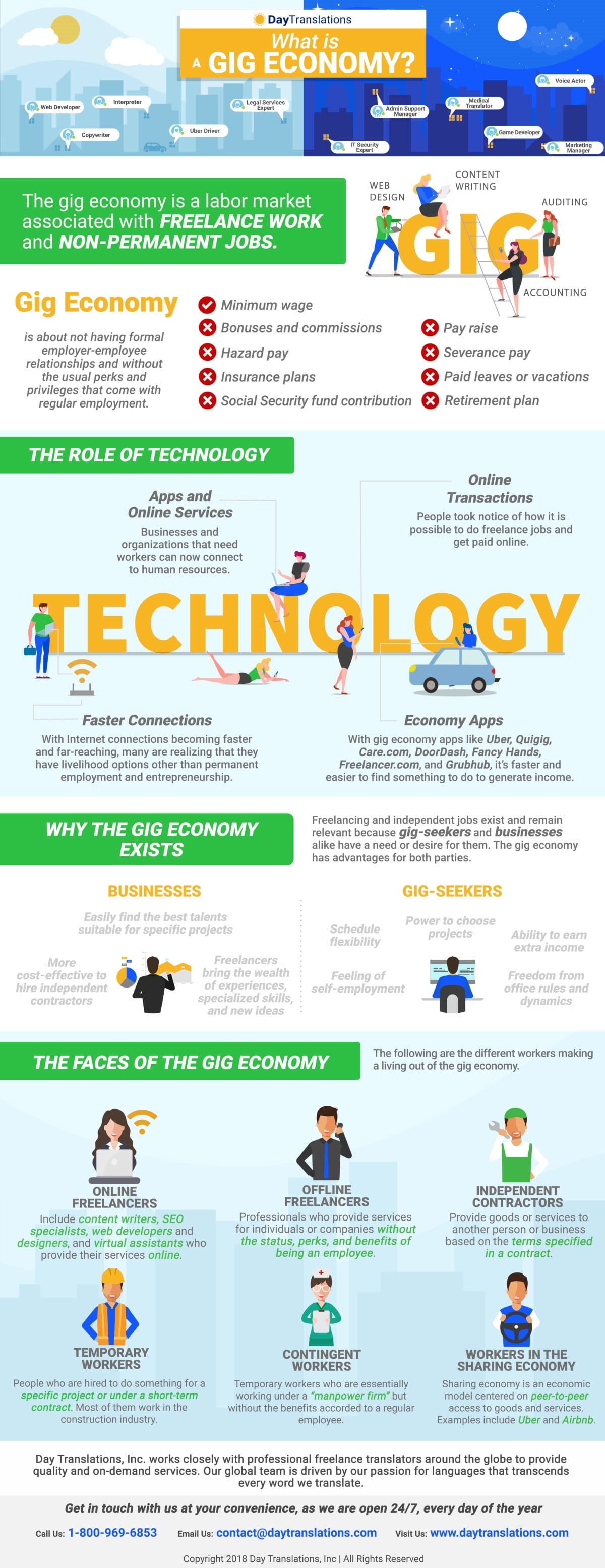
The gig economy is a labor market associated with, as mentioned, freelance work and non-permanent jobs. You may have heard of the word “gig” before, referring to the hiring of musicians for specific events or short-term engagements. This term takes on a new meaning as it encompasses all sorts of labor contracting. Content writing, web development, programming, accounting, auditing, and various other one-time and short-term jobs can also be referred to as gigs in the context of freelancing or independent contracting.
Essentially, being a worker in the gig economy is what being a traditional worker isn’t. Working on a “gig” basis entails being an unconventional employee (having an alternative job arrangement) or a non-employee working for a company or individual. If the underground economy is about not being regulated, recorded, and taxed by governments, the main attribute of the gig economy is not having formal employer-employee relationships. It’s about not getting tied to one company and having the option to quit or move to another establishment upon the completion of the short-term contract or project.
In some cases, independent contractors may ink a deal with a company for a long-term engagement, five years for example. Having a long-term relationship with a company does not constitute a traditional work setup, though, in the absence of an employee-employer relationship. It’s still considered as a gig when a worker does not get the usual perks and privileges that come with regular employment such as the following:
- Minimum wage
- Bonuses and commissions
- Hazard pay
- Insurance plans (HMO, life insurance, etc.)
- Social security fund contribution
- Paid leaves or vacations
- Maternity/Paternity/Adoption leave
- Pay raises
- Severance pay
- Retirement plans
- Participation in company outings or events
Gig economy: trend or rediscovery?
The gig economy didn’t just emerge all of a sudden. It did not start happening in 2018, 2017 or in the last three to five years. It has been part of the economies of the world, in the United States in particular, for several decades.
MBO Partners, in its eighth “State of Independence in America,” an annual study on the independent contracting and freelancing landscape in the US, made some notable conclusions. The following inferences can be drawn from these conclusions:
- The prevalence of freelancing is increasing, but this does not mean that traditional jobs are becoming obsolete. The growth in the gig economy does not appear that significant as a percentage of the entire labor market because traditional jobs are also growing.
- The number of available freelance jobs continues to grow along with workers’ interest in them. This is largely stimulated by economic factors, technological advancements, and innovations.
- The “new norm” is a mix of traditional and freelance/independent work. Hence, there is no shift in the labor market toward the gig economy. Many Americans have been doing both traditional and freelance work for a long time and are likely to continue doing so in the years to come.
- This fourth inference may sound dubitable, but the numbers don’t lie, at least as far as the United States job market is concerned. Based on data from the US Bureau of Labor Statistics, the percentage of the gig economy (in relation to the overall labor market) was lower in 2017 compared to the numbers from 2005 and even in the 1990s. The present American job market is not dominated by Uber and other sharing economy workers, freelancers, temporary contractors, independent workers, and others under an alternative job arrangement.
There may be other studies with different conclusions, but it’s not incorrect to say that people have been doing both traditional and alternative (sideline) work for a long time. Especially during periods of economic turmoil, many had to resort to juggling multiple jobs to make ends meet. For several decades, many have been doing both regular employment and one or more side jobs concurrently. So, it’s difficult to say whether or not the percentage of freelance workers is higher than that of regular employees since many of these traditional employees and freelancers could be the same people.
Freelance work and independent contracting are on an uptrend. Their prominence is increasing. Some even predict that they will eventually dominate the US labor market in the next few years. Growth and prominence, however, do not necessarily mean dominance. It can be said that the gig economy at present is more of a rediscovery induced by technological developments as discussed below.
The role of technology
The gig economy buzzword at present can be attributed to technological advancements and innovations. As Internet penetration continues to increase and web-enabled devices become easily accessible to more people, many take notice of how it is possible to do freelance jobs and get paid online, or use the internet and mobile devices to find work opportunities.
Through apps and online services that connect human resources to businesses or organizations (that need workers), freelancing and independent contracting are taking on new forms. It’s now easier for freelancers to find work compared to a time when they mostly had to rely on recommendations or referrals from previous clients to get new gigs.
With gig apps like Uber, Quigig, Care.com, DoorDash, Fancy Hands, Freelancer.com, and Grubhub, it’s faster and easier to find something to do to generate income. With Internet connections becoming faster and more far-reaching, many are realizing that they have livelihood options other than permanent employment and entrepreneurship. People are rediscovering the advantages of freelancing or being in an alternative work arrangement through the internet and apps in their mobile devices.
The faces of the gig economy
The following summarizes the different workers making a living out of the gig economy.
- Online freelancers. These are workers who get paid after providing their services or delivering products/output online. These include content writers, SEO specialists, web developers and designers, and virtual assistants.
- Offline freelancers. These are professionals and skilled workers who provide services for individuals or companies without the status, perks, and benefits of being an employee to an employer.
- Independent contractors. This is a broad term for people or businesses that provide goods or services to another person or business based on the terms specified in a contract. An independent contractor can be a plumber directly offering services to clients or a team of creatives who commit to a project for a business, organization, or individual. Online and offline freelancers can be independent contractors.
- Temporary workers. As the phrase implies, these are people who are hired to do something for a specific project or under a short-term contract. Most of them work in the construction industry. Temporary workers may go through a temp agency or temporary staffing firm to be matched to job opportunities.
- Contingent workers. These are temporary workers who are essentially working under a “manpower firm” but without the benefits accorded to a regular employee.
- Handymen. These are people who perform small tasks for others. Prospective clients may contact them or they may offer their services to potential clients after going through classifieds, online posts, or apps such as Care.com, Bellhops, Dolly, Fancy Hands, Gigwalk, and Handy.
- Workers in the sharing economy. Sharing economy is an economic model centered on a peer-to-peer based acquisition, provision, or sharing of access to goods and services. It also enables individuals and groups to earn income from underused assets, including physical assets, which are offered as services. Examples of workers in the sharing economy are drivers of ride-hailing apps such as Uber and property owners on Airbnb.
- Speaking of the latter, an Airbnb business plan can help hosts maximize their earnings and provide exceptional experiences for guests.
Arguably, it’s the sharing economy workers who serve as the poster child for the gig economy at present. Many articles written about freelancing and independent work mention how the age of Uber and Airbnb is changing the labor market.
Why the gig economy exists
Freelancing and independent jobs exist and remain relevant because gig-seekers and businesses alike have a need or desire for them. The gig economy has advantages for both parties.
Upwork’s Freelancing in America 2018 report lists top reasons why workers want an alternative work arrangement. These include schedule flexibility, the thought of being their own boss, and the power to choose projects to do and locations or settings to work in. Likewise, freelancing provides freedom from office rules and dynamics, opportunities for pursuing personal interests, and of course the ability to earn extra income.
On the other hand, businesses take advantage of the gig economy as it allows them to find the best talents suitable for specific projects or tasks. Many businesses prefer freelancers over full-time employees because of the wealth of experiences, specialized skills, and new ideas they bring. In the field of app localization, for example, it’s better to hire freelancers who are native speakers of the target language for localization. It’s nearly impossible to maintain a team of full-time employees who have the translation proficiency and precision needed to perfectly localize apps especially when it comes to less familiar languages, perform web localization services, and do other related solutions that would satisfy a wide range of clients.
Even better, it’s more cost-effective to hire independent contractors than to get regular employees as the latter have legally required perks and privileges that increase the operating costs of a business. The lack of an employee-employer relationship, moreover, means that a company can quickly let go of the freelancer in case of unsatisfactory performance
Controversy
Not everything is positive about the gig economy. It is a somewhat controversial topic. Unfortunately, some of its advantages for businesses are disadvantages to the workers. While Upwork’s 2018 report indicates that the majority of those who left their jobs to become freelancers said they earned more than what they were earning in their previous work, many say that they are paid lower than what regular employees get. It also does not help that they don’t enjoy security of tenure and are deprived of benefits and opportunities for professional growth.
Coping with the times
The gig economy is nothing new. It only looks different because of the infusion of new technology and innovation, which makes many aspects of freelancing and independent contracting significantly easier and faster. However, the advantages and drawbacks of the gig economy decades ago versus the one now are still largely similar.
It is a challenge for governments to regulate or introduce legislation that would address oppressive practices. Businesses and workers, on the other hand, have to work together to make the gig economy work to everyone’s benefit.
See the advantages of the gig economy through expert, freelance, native speaking translators and interpreters
Day Translations, Inc. is proud to be one of the examples that show the advantages of the gig economy. Our language service company hires freelance language experts from different parts of the world to perform contextually accurate translation, interpreting, localization, and other language solutions for different purposes. For all your language needs, don’t hesitate to contact us through email or by telephone at 1-800-969- 6853.
Share this Infographic On Your Site

Written by
Bernadine RacomaBernadine Racoma is a senior content writer at Day Translations, a human translation services company. After her long stint as an international civil servant and traveling the world for 22 years, she has aggressively pursued her interest in writing and research. Like her poetry, she writes everything from the heart, and she treats each written piece a work of art. She loves dogs!
Stay in the loop
Get the latest articles on translation, localization, and language delivered straight to your inbox.