Top 10 Countries With the Best Healthcare Systems
For years, the debate around which system of coverage is optimal has been carried out in the political arena of many countries. Hence the variety of the existing systems of healthcare that we can find today. While some states look for a way to provide…

6 min read
For years, the debate around which system of coverage is optimal has been carried out in the political arena of many countries. Hence the variety of the existing systems of healthcare that we can find today.
While some states look for a way to provide universal coverage relying completely on public resources, there are some nations that depend entirely on private insurers along with others that have a mixed system, like the U.S.
This article will be centered on the different types of healthcare systems today and their proven efficiency.
_______________________________________________________
Psst! This is part of our Hospital Expansion guide! Check it out for a more comprehensive approach to taking your healthcare facility international!
_______________________________________________________
What is healthcare?
Healthcare can be understood as the preservation and improvement of health through the prevention, diagnosis, and treatment of injuries, diseases, and any other physical or mental impairment. It includes different kinds of medical attention (physical therapy, nursing, psychology, among others) and the method by which it´s provided varies depending on the country, even municipality.
There are several economic and social elements that have a significant impact on any given healthcare system and this is largely due to the goals generally set for health systems. Here, we´ll mention three essential goals:
- Ensure that the population will access the health services provided by certified professionals and qualified attention.
- Achieve the right level of responsiveness of health assistance to the real expectations of the population. This means investing in the structural and institutional dimensions of the health system.
- The fairness and equity on the delivery of healthcare in a way that poor households don’t carry with a higher expense than they can afford.
Now, these are not the only factors that need to be considered to evaluate the right functioning of a healthcare system. The World Health Organization states that a high-quality healthcare system must also include well-maintained facilities, provide reliable information to patients, administrative efficiency, and, fundamentally, a steady financing mechanism.
So far, the importance of an efficient healthcare system has become clear. The lack of quality on it’s supply can bring unfavorable consequences whereas counting with a well-developed health system can protect a population’s quality of life and even life expectancy. And this is why health systems tend to be one of the biggest concerns for policymakers. Countries have been introducing reforms in the health sector so as to improve their performance. Increasingly, governments and private institutions are investing in healthcare software development services to modernize infrastructure and streamline operations for better outcomes.
Countries With the Best Healthcare Systems: The Best and Brightest
As mentioned before, there’s no secret formula. The countries that have achieved the best results in terms of healthcare have very different systems to organize it and, in the right context, they’ve proven to be successful.
An example of the existence of different schemes can be taken from Switzerland and Finland. In the Swiss case, there are no free state-provided health services since healthcare is not tax-based. Instead, it is paid by individuals through their contribution to Swiss healthcare schemes and this insurance covers 80-90% of healthcare costs. Unlike this, we have healthcare in Finland as a publicly funded system.
In Finland, there are two sources of healthcare funding: municipal financing trough taxes and National Health Insurance (NHI), financed by compulsory fees. NHI funds private and occupational healthcare and outpatient care.
This shows how different can healthcare systems be and still how favorable results they can be achieved.
The Legatum Prosperity Index, an annual ranking from the Legatum Institute, ranked 149 countries on certain factors such as wealth, health, personal well-being, quality of life and the availability of preventative care.
According to the 2019 report, here’s a list of the countries that count with the best healthcare:
- Singapore
- Japan
- Switzerland
- South Korea
- Norway
- Hong Kong
- Iceland
- Denmark
- Netherlands
- Austria
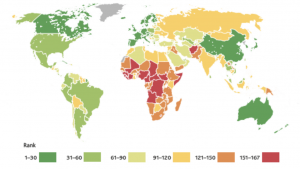
We’ll present you with a second classification that involves exclusively the countries with the most well-developed public healthcare systems. This was obtained by the 2020 Best Countries report which includes a sub-ranking analysis con Quality of Life.
This survey studies more than 20000 global citizens form four different regions of the world to assess perceptions of 73 countries on 65 metrics. Those metrics are qualitative characteristics (such as “Open for business” or “Citizenship”) that have the potential to affect national economies in terms of trade, travel, and investment.
Does this country’s culture influence business, education, and health decisions? Is it bureaucratic when it comes to business? Are government practices fully transparent? ? Do they count with a developed public health system? ? These are some of the attributes used to score and rank countries in this report.
Here is the resulting list:

No. 1: Canada
Best Health Care System Rank: 1
Best Countries Overall Rank: 2

No. 2: Denmark
Best Health Care System Rank: 2
Best Countries Overall Rank: 13

No. 3: Sweden
Best Health Care System Rank: 3
Best Countries Overall Rank: 8

No. 4: Norway
Best Health Care System Rank: 4
Best Countries Overall Rank: 10

No. 5: Germany
Best Health Care System Rank: 5
Best Countries Overall Rank: 4

No. 6: United Kingdom
Best Health Care System Rank: 6
Best Countries Overall Rank: 6

No. 7: Japan
Best Health Care System Rank: 7
Best Countries Overall Rank: 3

No. 8: Australia
Best Health Care System Rank: 8
Best Countries Overall Rank: 5

No. 9: Netherlands
Best Health Care System Rank: 9
Best Countries Overall Rank: 9

No. 10: Switzerland
Best Health Care System Rank: 10
Best Countries Overall Rank: 1
Language services? Make a big deal out of it
Providing trustworthy access to language services for patients is a lot more important than you might think. Healthcare providers could hire a staff of professional interpreters and translators to offer at least the most requested languages. This definitely speaks of the quality of the medical attention that a country is capable of providing.
Another possibility, if it’s not within the means of the healthcare system to employ language service companies, is asking for the help of family members or even bi-lingual staff to deal with interpretations when addressing their patients. The reason to emphasize this relies not only in a humanitarian perspective but in a legal indicator: lawsuits. Many of them are filed year after year against healthcare facilities because of the lack of proper language services that may result in malpractice.
Medical translations services are a must-have when it comes to a competitive healthcare system, and the countries ranked above demonstrate that investing in this area causes a positive healthcare outcome.

Written by
Day TranslationsThe Day Translations editorial team is composed of seasoned linguists, translators, and localization experts with a deep passion for language and cross-cultural communication. With decades of combined experience in translation, interpreting, and multilingual content creation, the team brings a unique perspective on the evolving world of global communication. Their insights reflect both academic expertise in linguistics and hands-on experience. Each article is crafted to inform, inspire, and support professionals navigating the multilingual landscape.
Stay in the loop
Get the latest articles on translation, localization, and language delivered straight to your inbox.