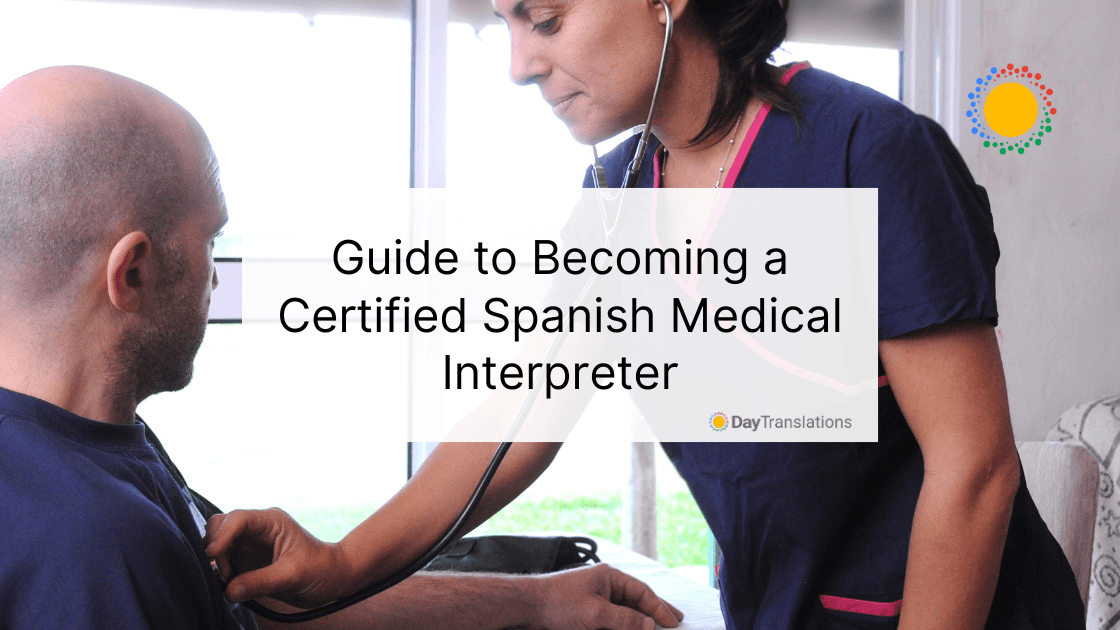
Guide to Becoming a Certified Spanish Medical Interpreter
Expert knowledge of the Spanish language can give you a lot of opportunities. As a global language, Spanish allows you to travel the world. It’s the national language of 20 countries and enjoys the enunciation of 437 million speakers worldwide. But if you want to…

5 min read
Expert knowledge of the Spanish language can give you a lot of opportunities. As a global language, Spanish allows you to travel the world. It’s the national language of 20 countries and enjoys the enunciation of 437 million speakers worldwide. But if you want to put your Spanish to use, there are more possibilities than just wandering abroad. If you feel drawn to help those in need, for example, you might consider becoming a certified Spanish medical interpreter.
Why Become a Certified Spanish Medical Interpreter?
The healthcare industry needs certified Spanish medical interpreters, especially in the United States, which now has more Spanish speakers than Spain–more, in fact, than any other country besides Mexico.
A medical interpreter provides vital services by translating between medical practitioners and people in crisis. It’s a sensitive task that requires precision and rapid, accurate delivery of technical terminology. If this high pressure, high reward career appeals to you, the first step is to get certified as a Spanish medical interpreter.
Certification is not always required to get a job as a medical interpreter. But it definitely helps. In a vocation where lives are sometimes hanging in the balance, certification demonstrates to your potential employers that you are as excellent as you claim to be. And that matters.
Let’s look at the steps you can expect to go through to become a certified Spanish medical interpreter.
National Board of Certification for Medical Interpreters Requirements
The National Board of Certification for Medical Interpreters has some specific prerequisites to qualify you before registering for certification. What do you need to register as a certified Spanish Medical Interpreter?
- A passport or government issued ID showing you’re at least 18 years old
- A United States high school diploma or GED
- 40 hours of training in medical interpretation
- International Medical Interpreters Association is a good resource for finding classes near you
- 3 credit hours of college study specific to being a medical interpreter will also qualify
- Demonstrated proficiency in English based on one of the following:
- A Bachelor’s degree, master’s degree, PhD, or other American college level degree
- A high school diploma from an English speaking country
- Passing one of the following tests:
- Test of English as a Foreign Language (TOEFL)
- A score of at least 570 on the paper test, 230 on the computer version, or 90 on iBT
- English Language Proficiency Test (ELPT)
- A score of 950 or higher
- Michigan English Language Assessment Battery (MELAB)
- 80 points or more
- Examination for the Certificate of Proficiency in English (ECPE)
- Scoring is pass/fail, but all possible results are Honors, Pass, Low Pass, Borderline Fail, and Fail. Passing score is sufficient.
- First Certificate in English, Level 3 (FCA)
- Grade A
- Certificate in Advanced English, Level 4 (CAE)
- Grade B
- Certificate of Proficiency in English, Level 5 (CPE)
- Grade B
- International English Language Testing System (IELTS)
- Score of 7.0
- Test of English as a Foreign Language (TOEFL)
- Demonstrated proficiency in Spanish based on one of the following:
- A Bachelor’s degree, master’s degree, PhD, or other university level degree from a Spanish speaking country
- A high school diploma from Spanish speaking country
- 24 or more credit hours of Spanish
- Passing the American Council on the Teaching of Foreign Languages (ACTFL) oral exams, either the OPI (telephone) or OPIc (computer) exam
- Proficiency levels are low-, mid- and high-level novice; low-, mid- and high-level intermediate; low-, mid- and high-level advanced; superior; and distinguished. Mid-level advanced is the requirement.
Review NBCMI’s Handbook
Once you have all of the prerequisites listed above and you’re ready to apply, it’s a good idea to review the candidate handbook from the National Board of Certification for Medical Interpreters. The handbook will walk you through application process, how to prepare for the certification exams, what to expect on exam day, and how to understand the scoring system.
You can take the exam from home, or from a testing center.
CCHI, Another Option for Medical Interpreter Certification
It’s worth comparing and contrasting NBCMI with the Certification Commission for Healthcare Interpreters (CCHI). Though they have basically the same prerequisite requirements and test for similar proficiencies, there are some minor differences.
To apply for certification with CCHI, you’ll first have to pass the computer-based CoreCHI exam. It’s 100 questions that cover the basics of medical interpreting.
CCHI and NBCMI have the same fees: $35 for registration, $174 for the written exam, and $275 for the oral exam. You can review CCHI’s candidate handbook and see if there’s a testing center near you.
Now You’re Certified as a Spanish Medical Interpreter!
Congratulations on getting certified! It’s a challenging process!
Once you’re certified, the job hunt begins. Certification puts you one step ahead, but that’s not all that employers look for. Experience goes a long way, so be prepared to do some volunteering or internship positions in order to get momentum. And be prepared to fill out the form immediately after completing your interpretation.
When you have built some relationships and proven your value on the ground, you’ll be looking forward to a long and flourishing career as a certified Spanish medical interpreter. And you can take pride in the fact that you’re putting your passion for language to good use!

Written by
Day TranslationsThe Day Translations editorial team is composed of seasoned linguists, translators, and localization experts with a deep passion for language and cross-cultural communication. With decades of combined experience in translation, interpreting, and multilingual content creation, the team brings a unique perspective on the evolving world of global communication. Their insights reflect both academic expertise in linguistics and hands-on experience. Each article is crafted to inform, inspire, and support professionals navigating the multilingual landscape.
Stay in the loop
Get the latest articles on translation, localization, and language delivered straight to your inbox.