Aramaic – An ancient language that is in danger of being lost
With less than half a million native speakers, Aramaic, the language of Jesus is about to be extinct. Aramaic is a living language that belongs to the Semitic language group, which includes Arabic, Tigrinya, Amharic and Hebrew. It has been spoken by countless peoples for 3,000…

3 min read
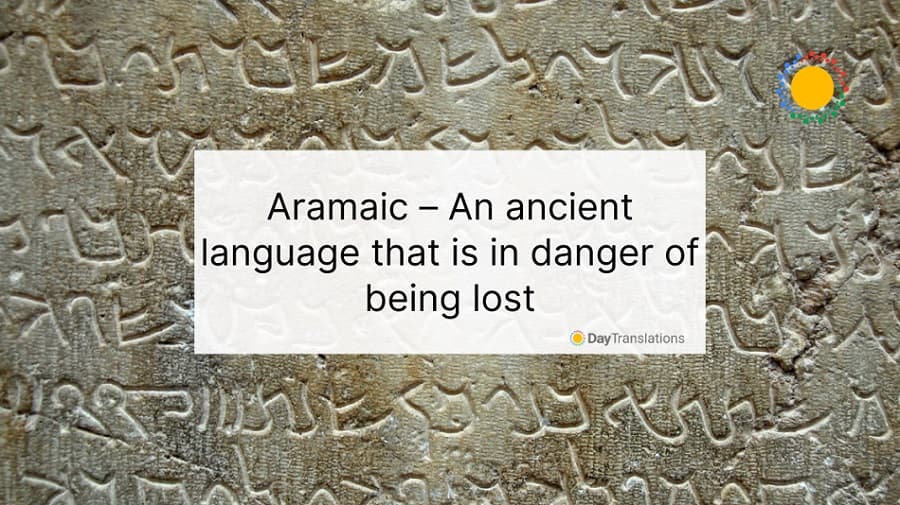
With less than half a million native speakers, Aramaic, the language of Jesus is about to be extinct.
Aramaic is a living language that belongs to the Semitic language group, which includes Arabic, Tigrinya, Amharic and Hebrew. It has been spoken by countless peoples for 3,000 years and is now on the brink of extinction, with only small groups of people speaking Aramaic. According to researchers, it is largely confined to the Assyrians. They are mostly living in Turkey, Iraq, Syria and Iran. It is said to be the language spoken by Jesus Christ.
Efforts to save the Aramaic language
With the speakers of Aramaic rapidly dwindling, scattered around the world through migration, efforts are being made to save the language. University of Cambridge professor Geoffrey Khan, a linguist, spends time to travel to different areas where native speakers are located, recording the language in an effort to preserve it for posterity. In the United States, a few thousand Aramaic speakers are living in the northern suburbs of Chicago.
Aramaic was once a dominant language, that is, until Arabian Muslims began to conquer the Middle East in the 7th century and Arabic became the de rigueur language. Native speakers moved further and further away from the city through the years and most are now found in the remote Kurdish villages. Professor Khan is establishing a web-based database of recordings and text of the Aramaic language.
Types of Aramaic
The language is made up of many types, labeled as dialects, due to its evolution, although some have become quite distinctly different from the original Aramaic. Two groups define the dialects, the Western and the Eastern groups. Old Aramaic was the oldest and spoken only by special teachers. Middle Aramaic is confined to the practice of religion and creation of special writings. The everyday dialects that are spoken by native speakers are part of Modern Aramaic.
The Western Neo-Aramaic is the only modern living Aramaic language that comes from the western group. It is believed that this is the only surviving dialect from the Western Middle Aramaic branch that was spoken in the 6th century. The rest have become extinct. Today it is only spoken in three remote and basically isolated villages of Bakh’a, Jubb’adin and Ma`loula in Syria.
The entire Middle East used to have only one common language and that was Aramaic. It was the language in business, commerce and governments from Egypt to Israel to India and all the way to China. It is part of the Bible and the Talmud. Jesus uttered his last words using Aramaic and it was the language used on the writing on the wall, which predicted the fall of Babylon and mentioned on the book of Daniel.
The stakes are high since it is predicted that by the end of this century, about 50% to 90% of the remaining 7,000 languages would likely disappear.

Written by
Bernadine RacomaBernadine Racoma is a senior content writer at Day Translations, a human translation services company. After her long stint as an international civil servant and traveling the world for 22 years, she has aggressively pursued her interest in writing and research. Like her poetry, she writes everything from the heart, and she treats each written piece a work of art. She loves dogs!
Stay in the loop
Get the latest articles on translation, localization, and language delivered straight to your inbox.